
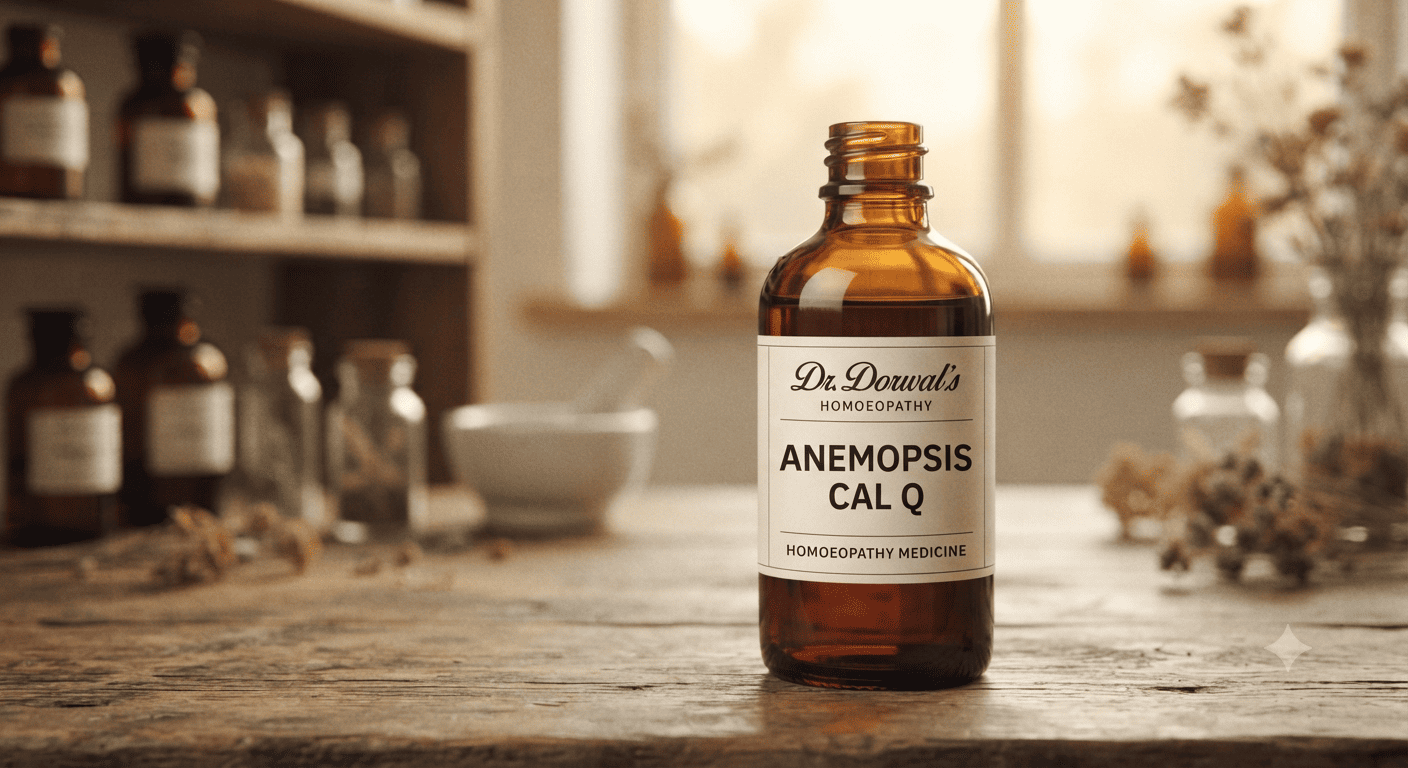
Anemopsis Californica (Yerba Mansa) is a traditional botanical agent with a broad range of applications, acting primarily as a tonic and restorative for mucous membranes. While it remains a niche remedy in modern homoeopathic practice, its historical reputation for managing catarrhal states and localized inflammation makes it an intriguing subject for the observant practitioner.
Key Clinical Indications & Uses
Therapeutic profile of Anemopsis is defined by its ability to restore balance to secretory surfaces and address states of hyper-reactivity:
- Mucous Membrane Tonicity: This remedy excels in chronic inflammatory states of Schneiderian membrane (the lining of the nasal cavities). It is indicated when there is significant tissue relaxation and profuse discharge, specifically in catarrhal conditions accompanied by a “full, stuffy” sensation in the head and throat.
- Versatile Secretory Support: Beyond the nasal passages, Anemopsis is found useful in addressing persistent mucous or serous discharges throughout the body, including diarrhoeal states and urethritis.
- Vulnerability and Trauma: Historically, it has been employed as a topical and internal support for cuts, bruises, and sprains.
- Cardiac and Digestive Regulation: It is recommended as a quieting agent for cases of cardiac distress where the heart is “unduly excited,” and it is noted for its ability to promote digestion and alleviate flatulence.
Administration & Dosage
- Dose: In clinical practice, it is used in Mother tincture (Q) form, both internally and as a local spray for catarrhal conditions.
Dr. Dorwal’s Perspective
As we continue to broaden our clinical scope, Anemopsis Californica presents as a remedy with promising, though yet-to-be-fully-systematized, potential. In my own clinical practice, I have not yet integrated this into my active protocols. However, the description of it as a “mucous membrane medicine” is significant. Any remedy that can address both the stuffiness of a chronic nasal catarrh and the “excited” state of an over-active heart suggests a remedy that has a grounding, normalizing effect on autonomic system.
In homoeopathic tradition, we often seek the remedy that can bring “tone” back to a relaxed, discharge-prone tissue. Anemopsis appears to do exactly that. For the practitioner who frequently sees patients with that chronic, nagging post-nasal drip or a throat that feels eternally congested, this remedy warrants a closer look. It is a reminder that our Materia Medica is a living library, and even these traditional “household herbs” often hold keys to the stubborn, chronic cases that cross our threshold.
Disclaimer: This content is for informational purposes only. Homoeopathic medicines should be taken under the guidance of a qualified homoeopathic physician. Do not self-medicate for chronic or serious medical conditions, and always seek professional advice for any health concerns.
Frequently Asked Questions (FAQs)
It acts as a tonic for the mucous membranes, particularly effective for chronic inflammation of the Schneiderian (nasal) membrane.
It is used for nasal/pharyngeal catarrh, diarrhea, urethritis, and as a quieting agent for cardiac excitement.
It is often used as a tincture, both taken internally and applied locally as a nasal/throat spray.
Historically, it has been used to assist in the healing of cuts, bruises, and sprains.
