Quick Overview
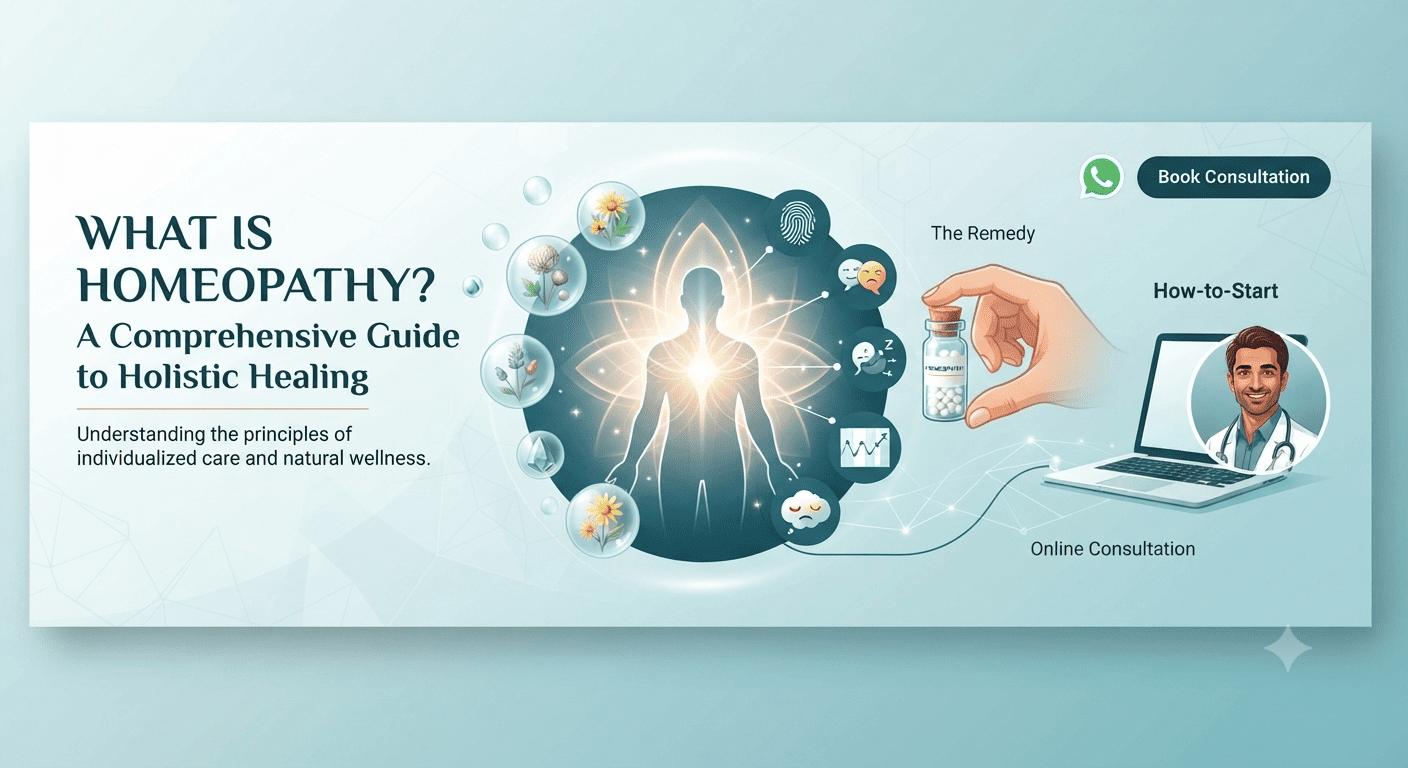
- Homoeopathy is a 200+ year old, individualised system of medicine founded by Dr. Samuel Hahnemann, based on the principle of “like cures like.”
- It uses highly diluted natural substances to gently stimulate the body’s own healing (“vital force”) instead of only suppressing symptoms.
- It is practised worldwide and is especially popular in India, Germany, France, and parts of Latin America.
- In India, a homoeopathic doctor (BHMS) is a government-registered medical practitioner, not an alternative or unqualified therapist.
Homoeopathy is generally considered gentle and safe, though mild, short-lived “healing reactions” can occur and it should never replace emergency medical care.
In This Guide
- 1. What is Homoeopathy? Meaning and Definition
- 2. Which is Correct: Homoeopathy or Homeopathy?
- 3. The Core Principles of Homoeopathy
- 4. How Does Homoeopathic Treatment Work in Practice?
- 5. What Does “Homoeopathy Care” Actually Involve?
- 6. Is a Homeopathic Doctor a Real Doctor?
- 7. What Are the Side Effects of Homoeopathy?
- 8. Which Country Uses Homoeopathy the Most?
- 9. How Long Does Homoeopathic Medicine Take to Work?
- 10. Why Don’t Homoeopathy Doctors Give ‘Prescriptions’ the Usual Way?
- 11. When Is the Best Time to Take Homoeopathic Medicine?
- 12. What Can Homoeopathy Help With? Common Conditions
- 13. Homoeopathic Medicines: A Brief Introduction
- 14. Homoeopathy vs. Conventional Medicine — A Quick Comparison
- 15. Homoeopathy, Yoga, and Diet: A Complete Lifestyle Approach
- 16. Choosing a Homoeopathy Doctor: What to Look For?
- 17. Final Gateway
1. What is Homoeopathy? Meaning and Definition
Homoeopathy meaning: Homoeopathy is a holistic, individualised system of medicine that treats a person as a whole — body, mind, and emotions — rather than treating an isolated disease name. The word itself comes from the Greek words ‘homoios’ (similar) and ‘pathos’ (suffering), literally meaning “similar suffering.” It refers to treating illness with a remedy capable of producing similar symptoms in a healthy person.
Homoeopathy was developed in the late 18th century by the German physician Dr. Samuel Hahnemann. He believed that the human body has an innate, self-healing ability, and that a carefully chosen, highly diluted remedy could stimulate this natural healing response rather than simply masking symptoms.
Today, homoeopathy is practised across the world as a complete system of medicine — with its own colleges, hospitals, government councils, and licensed physicians — and is used for both acute complaints (like fever or cold) and chronic, long-standing conditions (like metabolic disorders, allergies, or skin disease).
2. Which is Correct: Homoeopathy or Homeopathy?
Both spellings are correct and refer to the exact same system of medicine — the difference is purely regional, not scientific.
- Homoeopathy — The original, classical spelling, retaining the Greek ‘oeo’. Used in the UK, India, and most Commonwealth countries. This is also the spelling used in official Indian government bodies.
- Homeopathy — The simplified spelling commonly used in the United States and in casual/search usage worldwide.
In India, where the system is government-regulated, the official and legally correct term is “Homoeopathy,” as used by the Ministry of Ayush and the National Commission for Homoeopathy (NCH). Both spellings, however, are searched and understood interchangeably by patients.
3. The Core Principles of Homoeopathy
3.1 The Law of Similars — “Like Cures Like”
A substance capable of producing certain symptoms in a healthy person can, in a highly diluted and prepared form, help resolve similar symptoms in a person who is unwell. This is the founding principle of homoeopathy.
3.2 Minimum Dose
Homoeopathic remedies are prepared through a careful process of dilution and succussion (vigorous shaking), which is believed to increase the remedy’s healing action while minimising toxicity. This is why homoeopathic doses are extremely small compared to conventional medicine.
3.3 Individualisation
Homoeopathy does not believe in a single “one-size-fits-all” medicine for a disease name. Two people with the same diagnosis may receive two completely different remedies, based on their unique physical symptoms, emotional state, food preferences, sleep pattern, and overall constitution.
3.4 The Vital Force
Hahnemann proposed that a dynamic life energy, or “vital force,” maintains health, and that disease arises when this force is disturbed. Homoeopathic treatment aims to gently restore this internal balance rather than only suppressing an external symptom.
4. How Does Homoeopathic Treatment Work in Practice?
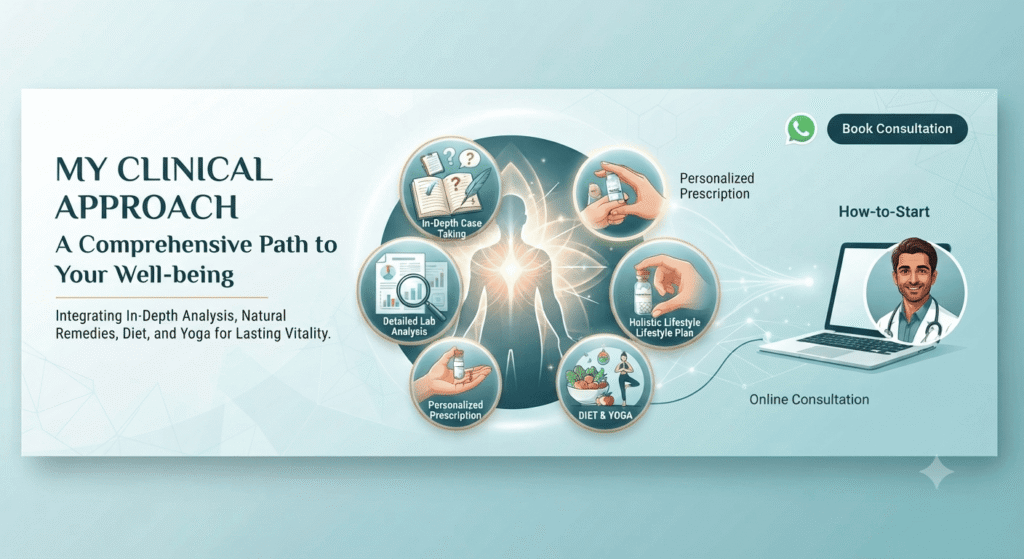
Unlike a five-minute conventional consultation, a homoeopathic case-taking session is detailed and conversational. A homoeopathic doctor typically explores:
- Your main complaint — What it feels like?, What makes it better or worse?, and When it started?
- Your general health?, Past illnesses?, and Family history?
- Your Emotional and Mental state? — Stress, Fears, Temperament, and Mood.
- Your lifestyle? — Appetite, Thirst, Sleep, and Reaction to weather or food.
Based on this complete picture, the doctor selects a remedy that best matches the totality of your symptoms, not just the disease label. This is why homoeopathic treatment can feel more personal and time-intensive than a standard prescription.
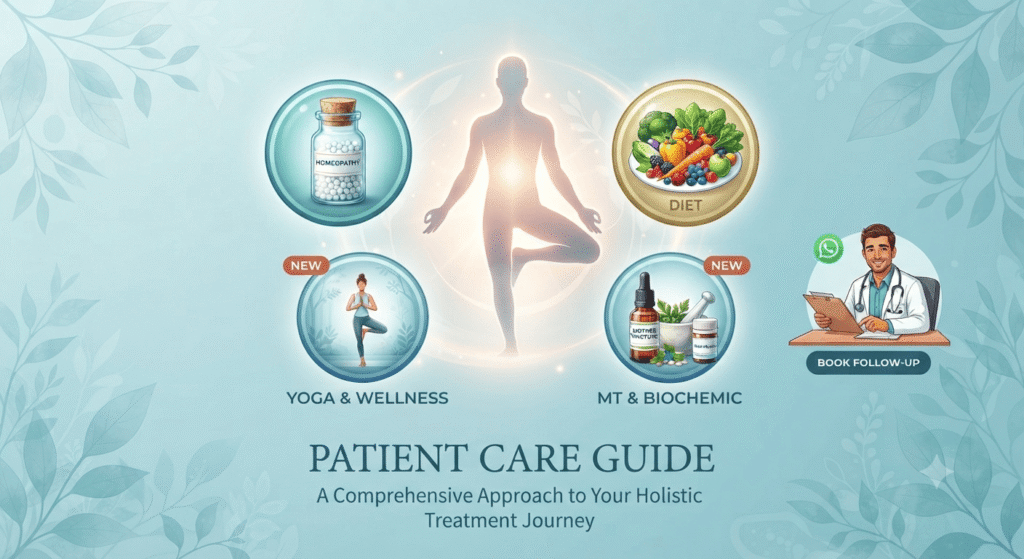
5. What Does “Homoeopathy Care” Actually Involve?
Homoeopathic care is not limited to handing over a medicine bottle — it is an ongoing, relationship-based process between doctor and patient. Good homoeopathic care typically includes:
- Detailed case history at the first consultation, often 30–60 minutes long.
- Personalised remedy selection matched to your unique symptom picture.
- Regular follow-ups to observe your body’s response and fine-tune the remedy or potency.
- Lifestyle guidance covering diet, sleep, and daily habits that support the remedy’s action.
- Long-term monitoring for chronic conditions, since deep-seated problems are addressed gradually and in stages.
This patient-centred model of care is what many people specifically search for when looking for “homoeopathy care” — a doctor who treats them as an individual, not just a diagnosis.
6. Is a Homeopathic Doctor a Real Doctor?
Yes. In India, a homoeopathic doctor who holds a BHMS degree (Bachelor of Homoeopathic Medicine and Surgery) is a fully qualified, government-registered medical practitioner. The BHMS is a 5.5-year professional degree (including a compulsory internship) recognised by the National Commission for Homoeopathy (NCH) under the Ministry of Ayush, Government of India.
A registered homoeopathic doctor:
- Completes formal medical college training in anatomy, physiology, pathology, and clinical medicine, alongside homoeopathic materia medica and philosophy.
- Is issued a registration number by the State Board of Homoeopathic Medicine, which must be displayed on prescriptions and clinic boards.
- Is legally permitted to diagnose, treat, and prescribe homoeopathic medicines to patients.
In short: a homoeopathic doctor is a real, licensed medical professional — practising a distinct system of medicine, with its own recognised medical curriculum and legal standing, not an informal or self-taught practitioner.
7. What Are the Side Effects of Homoeopathy?
Homoeopathic remedies are generally regarded as gentle and well-tolerated, since they are prepared in extremely small, diluted doses from natural sources such as plants and minerals. That said, a few points are worth understanding:
- Homoeopathic aggravation: Occasionally, symptoms can feel mildly and briefly more intense before improving — this is generally seen as a sign the remedy is acting, and it usually settles quickly.
- Low general toxicity: Because of the minimal dose, classical homoeopathic remedies are not associated with the kind of side effects seen with many conventional drugs.
- Safety depends on correct prescribing: As with any system of medicine, remedies should be taken under the guidance of a qualified homoeopathic doctor rather than self-prescribed for serious or ongoing conditions.
- Not a substitute for emergency care: Homoeopathy is not appropriate as the sole treatment for medical emergencies, acute surgical conditions, or life-threatening illness — these always need timely conventional/emergency medical attention.
Overall, when prescribed correctly by a trained physician, homoeopathy is considered a low-risk, gentle option suitable for people of most ages, including children and the elderly.
8. Which Country Uses Homoeopathy the Most?
India has the largest homoeopathic infrastructure in the world — the highest number of registered homoeopathic doctors, colleges, and users of any country, and homoeopathy is officially recognised as one of India’s national systems of medicine under the Ministry of Ayush.
Beyond India, homoeopathy also has a notably strong presence in:
- Germany — The birthplace of homoeopathy, with a long-standing pharmaceutical and clinical tradition.
- France — Historically one of the largest per-capita users of homoeopathic remedies in Europe.
- Brazil, Mexico and other Latin American countries — Where it is integrated into parts of the public health system.
- United Kingdom — With a long homoeopathic hospital tradition, alongside ongoing public debate about its role in the NHS.
9. How Long Does Homoeopathic Medicine Take to Work?
The time a homoeopathic remedy takes to show results depends heavily on whether the condition is acute or chronic:
- Acute conditions (Cold, Fever, Minor injuries, Indigestion): relief is often felt within a few hours to a few days.
- Chronic conditions (Metabolic disorders, Allergies, Skin disease, PCOS/PMOS, Migraine): improvement is usually gradual, often assessed over weeks to a few months, since the goal is to correct the underlying pattern, not just mask a flare-up.
Because homoeopathy works with the body’s own healing response rather than forcing an immediate chemical effect, patience and consistent follow-up with your doctor are an important part of the process, especially for long-standing health issues.
10. Why Don’t Homoeopathy Doctors Give ‘Prescriptions’ the Usual Way?
Patients sometimes notice that a homoeopathic doctor doesn’t hand over a long printed prescription the way a conventional doctor might. There are genuine clinical reasons for this:
- One remedy, chosen precisely: Classical homoeopathy typically prescribes a single, carefully selected remedy at a time, rather than a combination of several drugs — so there is simply less to list.
- Remedy names carry the full information: A remedy name (with its potency, such as 30C or 200C) already tells the pharmacist and doctor everything needed — unlike a chemical drug that needs a detailed dosing schedule.
- Dosage is individualised and adjusted at follow-up: Since response varies from person to person, many doctors prefer to review progress in person or verbally and adjust the frequency, rather than fixing a rigid long-term schedule upfront.
- Anti-doting substances must be avoided: Doctors often give verbal instructions (like avoiding coffee, mint, or camphor near dose-time) that matter more than a formal written prescription.
Note: A responsible homoeopathic doctor will still clearly give you prescription with the remedy name, potency, and how to take it? It is simply communicated differently from a conventional multi-drug prescription.
11. When Is the Best Time to Take Homoeopathic Medicine?
General guidance recommended by most homoeopathic physicians (always confirm the exact instructions with your own doctor, since this can vary by case):
- On an empty stomach: Ideally 30 minutes before or after food, to avoid the taste and residue of food interfering with the remedy.
- Avoid strong flavours around dose-time: Such as coffee, mint, toothpaste, or strongly spiced food, which some practitioners believe may reduce a remedy’s action.
- Consistent timing: Taking the remedy at roughly the same time each day (for chronic cases) helps maintain a steady effect.
- Clean hands, clean container: Avoid touching the pills directly and tip them into the cap or a clean spoon before taking.
Since dosing frequency (once daily, weekly, or as-needed for acute flare-ups) is decided based on your specific case, always follow the exact schedule given by your prescribing doctor rather than a generic rule.
12. What Can Homoeopathy Help With? Common Conditions
Homoeopathy is used as a system of medicine across a very wide range of acute and chronic conditions, including:
- Skin conditions — Acne, eczema, Psoriasis, Dandruff, Hair fall/Alopecia etc.
- Respiratory conditions — Asthma, Allergic rhinitis, Bronchitis, Common cold, Influenza etc.
- Digestive conditions — GERD, IBS, Constipation, Peptic ulcers, Indigestion etc.
- Hormonal & metabolic conditions — Hypothyroidism, Hyperthyroidism, Diabetes mellitus, PCOS/PMOS etc.
- Joint & bone conditions — Cervical spondylosis, Back pain, Osteoporosis
- Lifestyle & mental well-being — Anxiety, Burnout, Sleep issues
You can explore symptoms, causes, and homoeopathic approaches for each condition in detail in our full Diseases & Symptoms library, covering conditions from A to Z.
13. Homoeopathic Medicines: A Brief Introduction
Homoeopathic medicines are prepared from natural sources — plants, minerals, and other substances — through a regulated pharmaceutical process of dilution and potentisation. Common forms include:
- Mother Tinctures (Q) — Concentrated liquid extracts, often used for specific organ or system support.
- Dilutions (like 30C, 200C, 1M) — Potentised remedies used based on the depth and nature of the case.
- Biochemic / Tissue remedies — Based on essential mineral salts of the body.
Every remedy has a specific symptom picture it is known to address, which is why self-medicating with homoeopathy for anything beyond very minor, familiar complaints is best avoided — professional case-taking greatly improves accuracy and results.
14. Homoeopathy vs. Conventional Medicine — A Quick Comparison
A simple side-by-side view of how the two approaches typically differ:
| Aspect | Homoeopathy | Conventional Medicine |
| Treatment focus | Whole person — physical, mental, emotional | Primarily the diagnosed disease/organ |
| Dosage | Minimal, highly diluted doses | Standard pharmacological doses |
| Approach to disease | Stimulates the body’s own healing response | Directly targets pathogens/pathology |
| Prescription style | Single, individualised remedy | Often multiple drugs for symptom control |
| Best suited for | Chronic, constitutional & lifestyle conditions | Emergencies, surgery, acute infections |
Note: Two systems are not necessarily competitors — many patients use homoeopathy for chronic, constitutional care while relying on conventional medicine for emergencies and acute crises, ideally under transparent communication between both doctors.
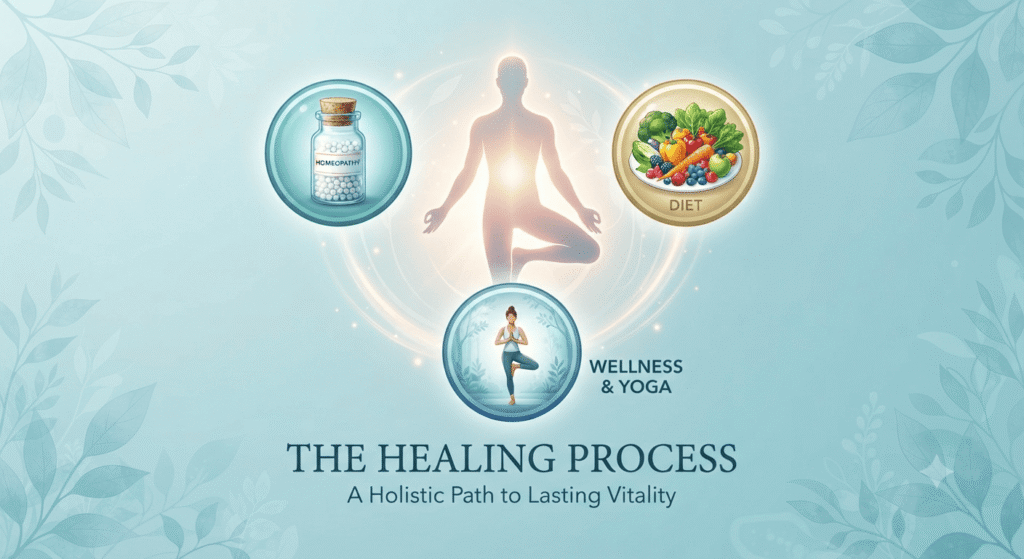
15. Homoeopathy, Yoga, and Diet: A Complete Lifestyle Approach
Because homoeopathy treats the whole person, it works best alongside supportive daily habits rather than in isolation. Many chronic conditions respond faster when treatment is combined with:
- Yoga — For stress reduction, better digestion, hormonal balance, and improved sleep.
- A suitable diet — Tailored to your constitution and condition, supporting the remedy’s action rather than working against it.
This is why a well-rounded homoeopathic practice looks beyond the remedy bottle alone, and also guides patients on yoga and diet as part of the overall care plan.
16. Choosing a Homoeopathy Doctor: What to Look For
- A valid BHMS degree and active registration number with the State Board of Homoeopathic Medicine.
- A thorough, unhurried case-taking process rather than a rushed, symptom-only consultation.
- Clear communication about the remedy, expected timeline, and realistic outcomes.
- Transparent guidance — Including when a condition needs to be referred for conventional/emergency care.
17. Final Gateway
Homoeopathy is a complete, time-tested system of medicine that looks at you as a whole person — not just a diagnosis. With a qualified doctor, a detailed case history, and a bit of patience, it offers a gentle, personalised path toward long-term, root-cause healing for both acute and chronic health concerns.
Disclaimer: The content above is intended for general awareness and should not be used as a substitute for a consultation with a qualified homoeopathic physician. Individual results vary from patient to patient depending on the case.