
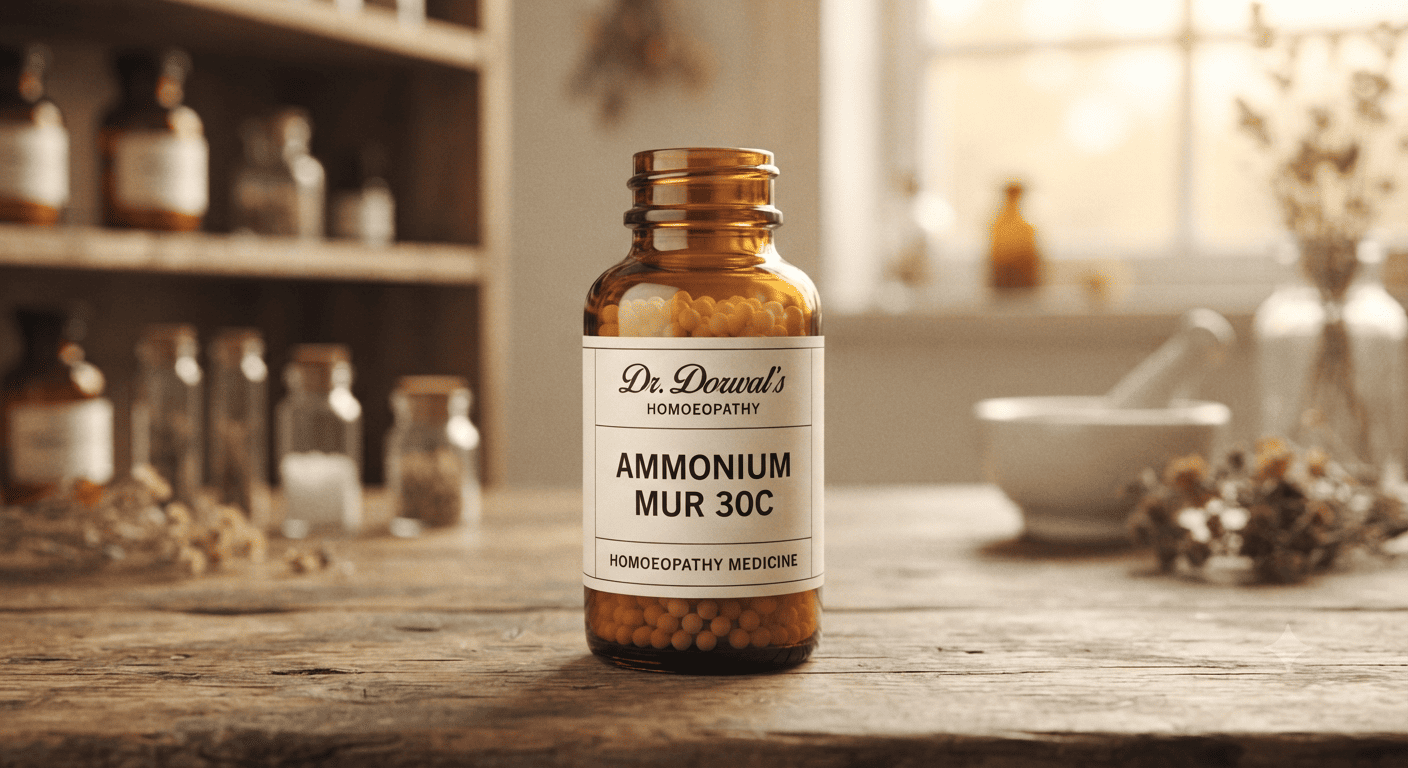
Ammonium Muriaticum (Sal Ammoniac) is a powerful, deep-acting remedy with a specific affinity for mucous membranes and hepatic-respiratory axis. It is frequently indicated in cases characterized by excessive, tenacious secretions and a state of systemic prostration that may mirror a “typhoid-like” clinical picture.
Key Clinical Indications & Uses
Therapeutic profile of Ammonium Muriaticum is defined by a unique pattern of localized symptoms and distinct temporal modalities:
- Respiratory & Hepatic Congestion: It is uniquely suited to “fat and sluggish” patients suffering from chronic respiratory catarrhs. It addresses liver conditions involving chronic congestion and splenic stitches, particularly in the morning.
- Nature of Catarrh: A hallmark of this remedy is profuse, glairy, and tenacious mucus that is difficult to expectorate. Whether in the nose (with acrid, corrosive discharge) or the throat (with a persistent sore spot behind the uvula), the patient feels as though they must constantly clear the airway.
- Neuralgic and Rheumatic Pains: It is highly effective for sciatica that is worse while sitting and better when lying down. It is also indicated for “ulcerative” pains in the tips of the fingers and toes, and a sensation of icy coldness between the shoulder blades that remains unmoved by external warmth.
- Rectal and Abdominal Disturbance: It addresses constipation with hard, crumbly stools or those covered in glairy mucus. It is also a key consideration for haemorrhoids that arise following the suppression of leucorrhoea.
Administration and Modalities
- Temporal Modalities: Remedy exhibits a fascinating chronological pattern: head and chest symptoms are worse in the morning, abdominal symptoms in the afternoon, and pains in the limbs, skin, and feverish states in the evening.
- General Modalities: Patients generally feel better in open air.
- Dose: In clinical practice, it is typically utilized in 30C potency.
Dr. Dorwal’s Perspective
In my clinical practice, Ammonium Muriaticum is first remedy that I consider for patient whose body seems to be in a constant state of “internal turmoil” due to unresolved grief or stubborn, catarrhal congestion. When a patient presents with a cough that seems to be glued to their chest, combined with that characteristic “icy coldness” between the shoulder blades, Ammonium Mur acts with a specificity that few other remedies can match.
What I find most instructive is the timing of its symptoms. In homoeopathy, we often talk about “modalities,” but Ammonium Mur provides a clinical lesson in how pathology shifts throughout the day. If a patient’s chest feels tight at dawn but their belly becomes agitated by the afternoon, I don’t look for a second remedy—I reach for Ammonium Mur. It is a remedy that respects the rhythm of patient’s discomfort, proving that even in the most sluggish, prostrate states, the body’s internal clock remains a vital guide to the correct prescription.
Disclaimer: This content is for informational purposes only. Homoeopathic medicines should be taken under the guidance of a qualified homoeopathic physician. Do not self-medicate for chronic or serious medical conditions, and always seek professional advice for any health concerns.
Frequently Asked Questions (FAQs)
It is especially adapted to stout, sluggish individuals who struggle with chronic respiratory and hepatic congestion.
It is typically dry, hacking, and scraping, and often associated with profuse, glairy, and difficult-to-raise mucus.
It is a significant remedy for sciatica that is aggravated by sitting and for neuralgic, “ulcerative” pains in the extremities.
It has distinct periods of aggravation: morning for the head/chest, afternoon for the abdomen, and evening for the limbs and skin.
