
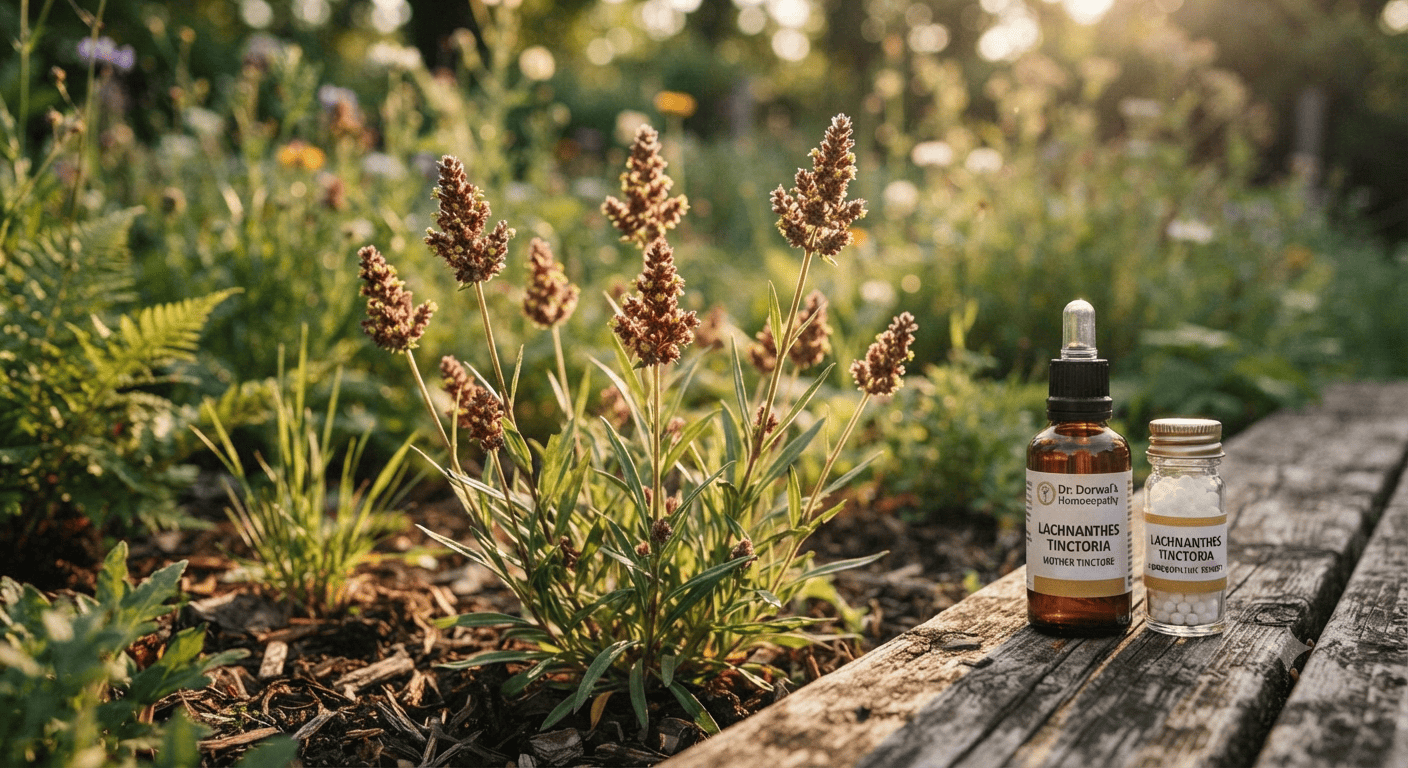
Lachnanthes Tinctoria, commonly known as Spirit-weed, occupies a unique position in the homoeopathic materia medica. It is a profound remedy with a specific affinity for the cervical region, the thoracic cavity, and the vasomotor system. Unlike remedies that target general malaise, Lachnanthes acts as a corrective influence on conditions characterized by stiffness, coldness, and localized vascular congestion, while simultaneously offering support for those experiencing cognitive or communicative inhibition.
Key Benefits & Uses
Lachnanthes is indicated for states of localized muscular rigidity and disrupted circulatory sensations:
- Torticollis & Cervical Rigidity: This is a primary remedy for acute or chronic neck stiffness. It is specifically indicated when the head is drawn to one side due to muscle contraction, often accompanied by the sensation that the nape of the neck is dislocated or severely strained.
- Rheumatic & Neuralgic Pain: It addresses rheumatic symptoms localized in the neck and shoulders. The pain is often right-sided, radiating toward the jaw, and is highly sensitive to noise or environmental stimulus.
- Circulatory & Thermal Discomfort: Lachnanthes is indicated for patients who experience a paradoxical sensation of “bubbling or boiling” heat around the heart that rises toward the head, contrasting sharply with a sensation of icy coldness in the body or between the shoulder blades.
- Cognitive & Expressive Empowerment: Often overlooked, this remedy is known to alleviate states of mental withdrawal. It is indicated for individuals who struggle with articulation or fear of public speaking, helping to stimulate a fluid flow of language and the confidence to express oneself.
- Respiratory & General Support: Historically, it has been utilized in the early stages of chest conditions and tuberculosis, particularly in fair-complexioned individuals who suffer from significant chilliness and localized skin redness (circumscribed red cheeks).
Administration & Therapeutic Modalities
- Potency Selection: While the 30C potency is common for acute musculoskeletal issues, the Mother tincture (Q) may be utilized in chronic or systemic chest conditions. Given its deep action on the vasomotor system, professional guidance is mandatory to determine the appropriate dilution and frequency.
- Symptom Assessment: Because Lachnanthes produces highly specific sensations—such as the feeling that the bridge of the nose is being pinched or that the scalp is sore as if the hair is standing on end—it is most effective when the patient’s subjective symptoms align precisely with the remedy’s clinical picture.
- Supportive Care: It is often used as an intercurrent or acute remedy for “stiff-neck” presentations, provided there is no severe inflammatory pathology requiring emergency intervention.
Dr. Dorwal’s Perspective
In my clinical practice, I consider Lachnanthes tinctoria the preeminent remedy for the “rigid” patient—not merely in a psychological sense, but physically. When a patient presents with a torticollis that refuses to resolve with standard inflammatory protocols. It is important to clarify that I do not utilize this medicine personally; however, homoeopathic literature consistently highlights the remedy’s fascinating duality. According to these classical texts, it treats the physical constriction of the neck while simultaneously addressing the “stiffness” of the mind—helping a patient who is physically restricted and perhaps socially or verbally inhibited to regain their natural fluidity. It is documented as a remedy that brings “heat” and “courage” back to a system that feels cold, retracted, and withdrawn.
Disclaimer: This content is for informational purposes only. Homeopathic medicines should be taken under the guidance of a qualified homeopathic physician. Do not self-medicate for chronic or serious medical conditions, and always seek professional advice for any health concerns.
Frequently Asked Questions (FAQs)
While it is world-renowned for torticollis and neck stiffness, it is a constitutional remedy that also addresses circulatory disturbances, specific types of headaches (with scalp tenderness), and even low confidence or “stuttering” in speech.
It does not treat heart disease directly, but it modulates the vasomotor nerves. It is particularly helpful when a patient experiences “boiling” sensations in the chest that radiate to the head, often accompanied by cold extremities.
Yes, it is highly specific for the sensation of the bridge of the nose being pinched, as well as the feeling that the neck muscles are pulled or dislocated.
If the injury is traumatic (e.g., a car accident), other remedies like Arnica or Hypericum are usually the first line of defense. Lachnanthes is indicated when the stiffness is rheumatic, chronic, or associated with specific postural or neurological-type tensions.
