
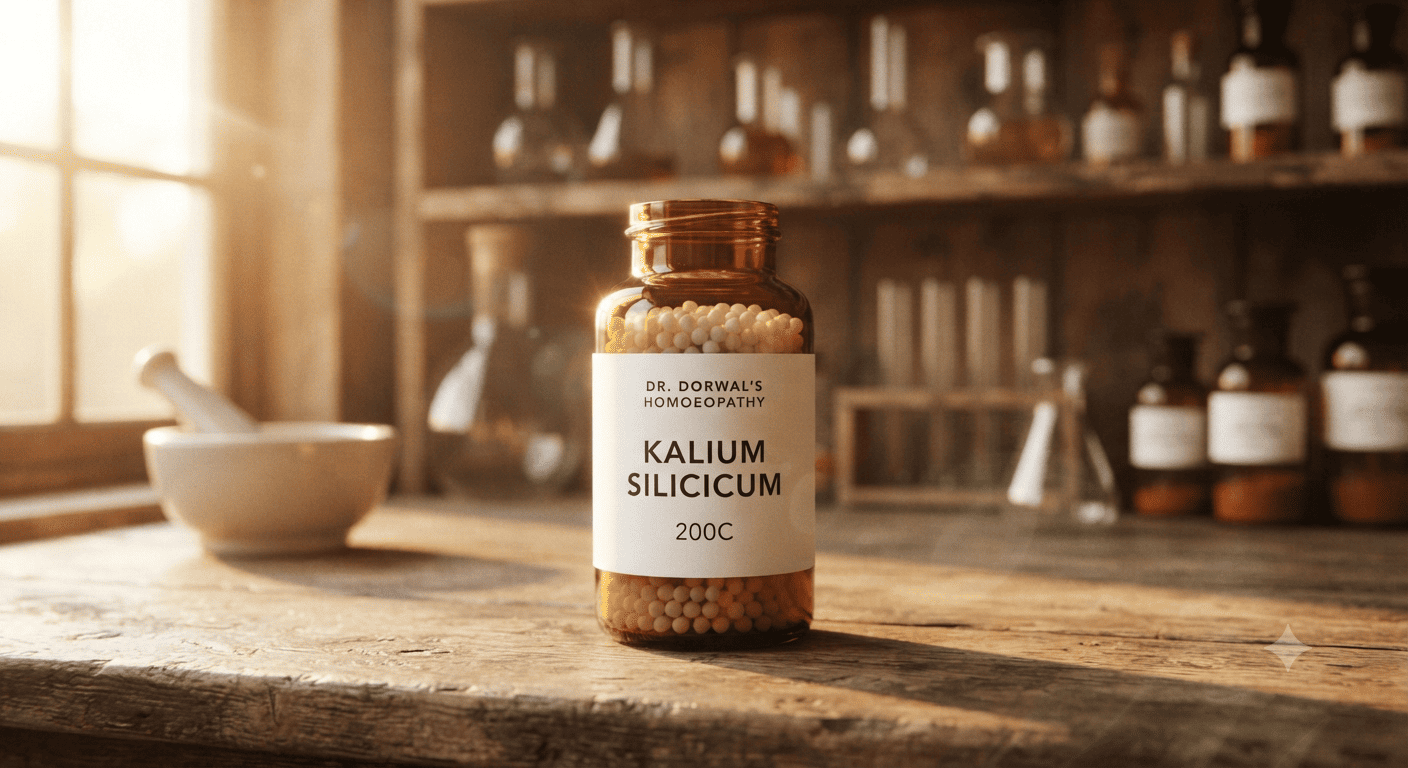
Kalium Silicicum (Silicate of Potash) is a deep-acting remedy in the homoeopathic pharmacopoeia, noted for its profound impact on constitution and vitality. It is specifically indicated for states characterized by extreme lassitude, physical emaciation, and a significant lack of nerve and muscle power. When the body presents with chronic weakness and a persistent desire to remain at rest, Kalium Silicicum serves to address the underlying constitutional imbalance.
Key Benefits & Uses
Kalium Silicicum acts on multiple systems to restore strength to an exhausted constitution:
- Deep-Seated Lassitude: The hallmark of this remedy is a marked sense of exhaustion. The patient experiences a persistent desire to lie down, accompanied by a feeling of weakness and weariness that affects the entire body.
- Cognitive & Mental Support: It addresses states of mental indolence, anxiety, and timidity, often accompanied by a feeble will power and an absent-minded nature.
- Congestive Head Symptoms: Indicated for head congestion where blood surges from the body to the head, accompanied by vertigo, coldness of the head, and photophobia (sensitivity to light).
- Respiratory & Nasal Affections: Effective for nasal catarrh characterized by bloody, offensive, and excoriating discharges, often associated with a swollen or ulcerated state of the nasal passages.
- Gastric & Digestive Regulation: It targets sensations of weight in the stomach following meals, nausea, and flatulence. It also addresses pain in the liver region and issues related to constipation, including a feeling of constriction in the anus during stool.
- Musculoskeletal Relief: Helps relieve stiffness and twitching of muscles throughout the body and limbs, often accompanied by a creeping sensation in the extremities.
Administration & Therapeutic Modalities
- Potency Selection: Kalium Silicicum is recognized as a deep-acting agent, and higher potencies (Such as 200C) are generally favored to address its constitutional sphere of action.
- Absorption: For maximum therapeutic effect, Globules should be dissolved slowly on the tongue. Please avoid eating or drinking for 20 minutes before or after administration to ensure optimal sublingual absorption.
- Modalities: Symptoms calling for this remedy are characteristically worse from exposure to open air, cold, drafts, exertion, motion, uncovering, or bathing.
Dr. Dorwal’s Perspective
In my clinical practice, Kalium Silicicum is my preferred remedy for the patient who presents with ‘profound weariness.’ When a patient lacks the physical or mental stamina to engage with their daily life and shows signs of constitutional emaciation, I look to this medicine to initiate a deeper, more structural healing process. It works well for those who feel physically stiff and mentally timid, helping to pull the patient out of a state of chronic indolence and back toward a state of improved vigor and will.
Disclaimer: This content is for informational purposes only. Homoeopathic medicines should be taken under the guidance of a qualified homoeopathic physician. Do not self-medicate for chronic or serious medical conditions, and always seek professional advice for any health concerns.
Frequently Asked Questions (FAQs)
The primary indication is deep-seated physical and mental lassitude, where the patient feels weak, weary, and has a constant desire to lie down.
Yes, it is effective for gastric complaints such as a heavy feeling in the stomach after eating, flatulence, and constipation with rectal constriction.
It addresses congestion where blood surges to the head, vertigo, and sensitivity to light, while also helping with muscle twitching and a creeping sensation in the limbs.
It is termed deep-acting because it addresses chronic constitutional states—such as emaciation and persistent weakness—rather than just superficial, short-lived symptoms.
