
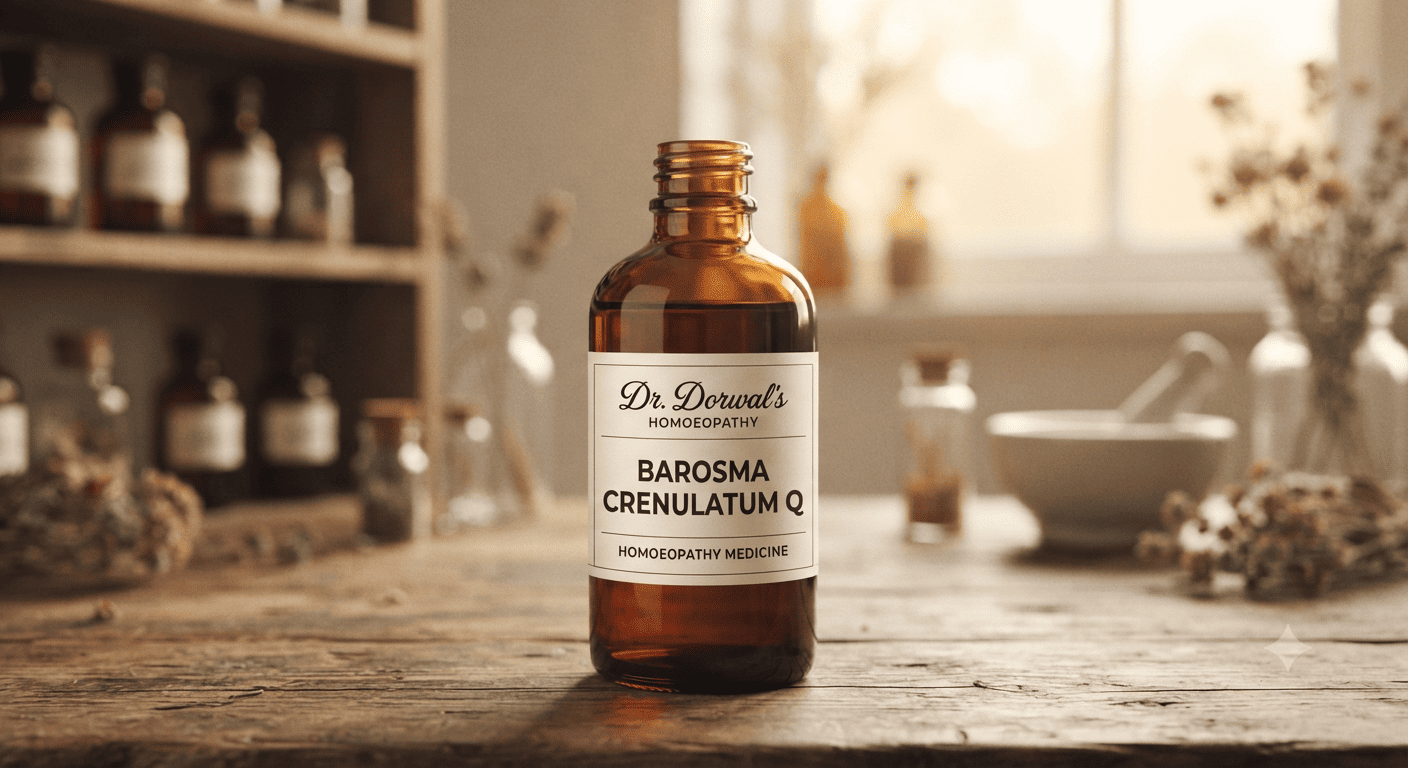
Barosma Crenulatum, commonly known as Buchu, is a revered botanical agent with a targeted affinity for genito-urinary tract. Derived from the leaves of shrub, its traditional and homoeopathic profile is centered on the clearance of mucous membrane inflammations, catarrhal secretions, and structural irritations within the urinary apparatus.
Key Clinical Indications & Uses
Therapeutic profile of Barosma Crenulatum is defined by its focused action on kidneys, bladder, and associated excretory channels:
- Genito-Urinary & Vesical Catarrh: It exerts a marked specific effect on the genito-urinary system, making it a primary consideration for chronic muco-purulent discharges.
- Irritable Bladder: It is indicated for irritable bladder states characterized by constant urging, vesical catarrh, and painful urination.
- Prostatic & Calculous Affections: It covers functional and inflammatory prostatic disorders, as well as the tendency toward urinary gravel and calculous formations.
- Leucorrhea: In female reproductive sphere, it addresses persistent, catarrhal leucorrheal discharges.
Administration & Dosage
- Dose: In classical phytotherapeutic and homoeopathic administration, it is traditionally utilized in form of Mother tincture (Q) or a soothing tea prepared from the leaves.
Dr. Dorwal’s Perspective
In practice of medicine, we often study remedies that act as specialized drains for specific organ systems. Barosma Crenulatum, or Buchu, stands out as a classic herbal and homoeopathic organ-remedy for the lining of urinary tract. When a patient presents with that persistent, distressing vesical catarrh—where bladder is irritable, urine carries a heavy muco-purulent sediment, and the prostate is congested—Buchu offers a very clear picture of local corrective action.
However, clinical practice requires a refined selection of remedies tailored to our active protocols. Because my primary therapeutic framework relies on deeply acting constitutional polychrests and targeted organ remedies that I have extensively tested in daily care, I still have not utilized this medicine in practice. Nevertheless, understanding its specific botanical affinity for urinary gravel and catarrhal bladder irritation ensures our clinical foundation remains comprehensive and well-rounded.
Disclaimer: This content is for informational purposes only. Homoeopathic medicines should be taken under the guidance of a qualified homoeopathic physician. Do not self-medicate for chronic or serious medical conditions, and always seek professional advice for any health concerns.
Frequently Asked Questions (FAQs)
It has a marked specific effect on genito-urinary system, particularly the bladder, prostate, and kidneys.
It is indicated for irritable bladder, vesical catarrh with muco-purulent discharges, and the presence of urinary gravel.
Traditional usage often relies upon the Mother tincture (Q) or an infused tea made from the leaves of plant.
Yes, it is historically noted for addressing catarrhal leucorrheal discharges.
