
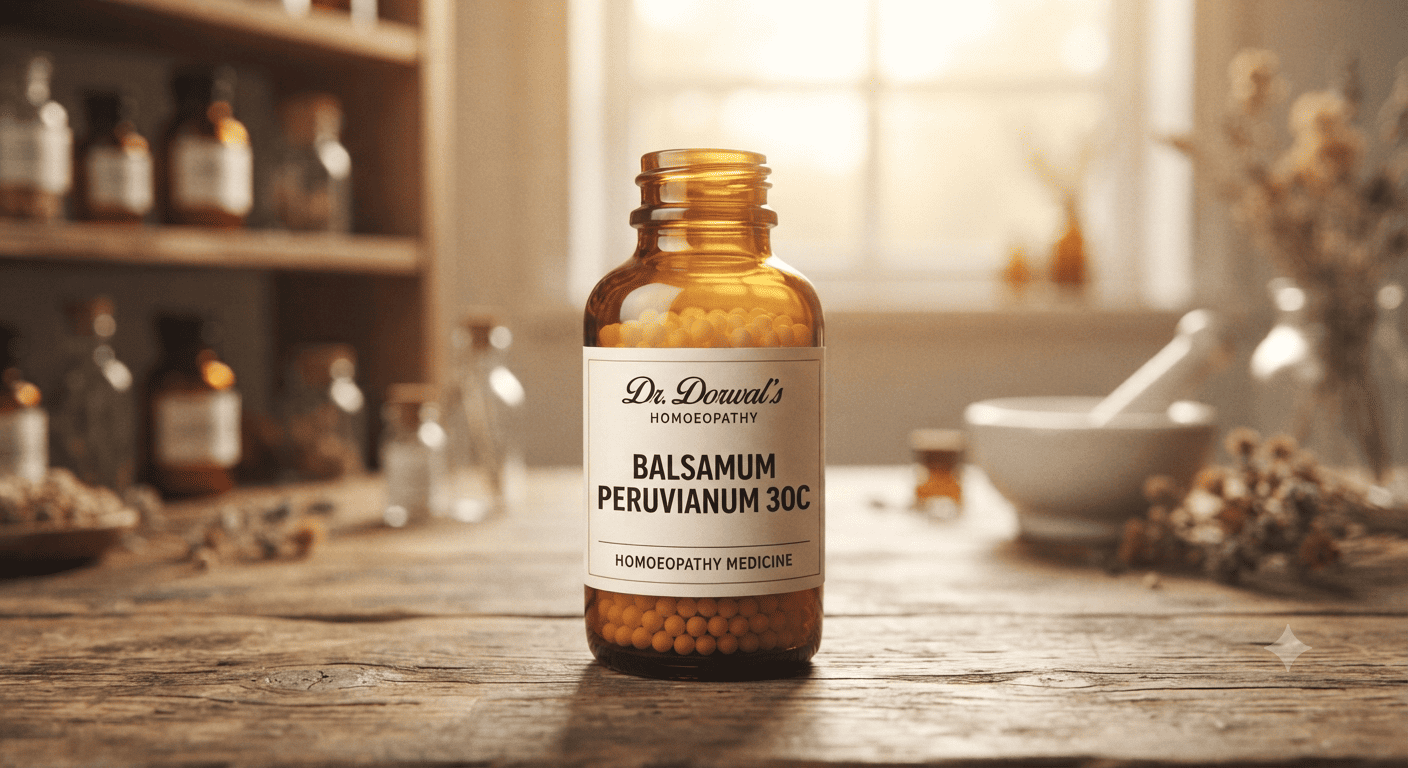
Balsamum Peruvianum, derived from the Myroxylon Pereirae tree, is a notable agent in homoeopathic and broader medical pharmacopoeia, celebrated for its profound impact on mucous membranes, purulent catarrhal states, and compromised skin integrity. Its historical utility spans both internal administration and local therapeutic applications.
Key Clinical Indications & Uses
Therapeutic profile of Balsamum Peruvianum is centered on its ability to manage heavy, purulent discharges and deep-seated catarrhal inflammation:
- Respiratory & Bronchial Affections: It is a targeted remedy for chronic bronchitis, pulmonary phthisis, and bronchial catarrh accompanied by copious, thick, creamy, muco-purulent expectoration. Chest picture is marked by loud rales, a very loose cough, and in some presentations, a hectic fever accompanied by debilitating night sweats.
- Nasal & Mucosal Congestion: It addresses chronic, fetid nasal catarrh characterized by a profuse, thick discharge, often complicated by localized eczema and ulceration.
- Gastrointestinal & Urinary Catarrh: It covers gastric catarrh accompanied by vomiting of food and mucus. In urinary sphere, it is indicated for bladder catarrh presenting with scanty urine and a heavy mucous sediment.
- Topical & Extra-Homoeopathic Utility: Locally, it has a long history of use as a powerful stimulant for raw surfaces, indolent ulcers, cracked nipples, rhagades, and scabies. It promotes healthy granulation tissue and helps eliminate fetor.
Administration & Dosage
- Dose: In homoeopathy, first attenuation is traditionally utilized, moving to the 6X potency or Higher, specifically for hectic fever states.
- External Application: Extra-homoeopically, a 1% solution in alcohol or ether has been used via an atomizer for respiratory support, while internal use as a crude expectorant historically involved 5 to 15 minims prepared as an emulsion.
Dr. Dorwal’s Perspective
In practice of homoeopathy and medicine, we continually encounter substances with rich historical backgrounds and distinct organ affinities. Balsamum Peruvianum presents a very clear clinical picture: it is a specialist in heavy, foul, purulent catarrh—whether pouring from bronchial tubes, nasal passages, or lining of the bladder. Its ability to stimulate healing in sluggish, ulcerated tissues, both internally and externally, speaks to its powerful drying and restorative nature.
However, clinical practice requires a targeted approach based on personal operational experience and reliable outcomes of established protocols. Because my current practice framework is well-supported by other polychrests and organ-specific remedies for chronic bronchitis and catarrhal states. I have not yet utilized this medicine in practice, But understanding its unique role in managing creamy, purulent expectoration and indolent tissue repair broadens the practitioner’s perspective on botanical balsams.
Disclaimer: This content is for informational purposes only. Homoeopathic medicines should be taken under the guidance of a qualified homoeopathic physician. Do not self-medicate for chronic or serious medical conditions, and always seek professional advice for any health concerns.
Frequently Asked Questions (FAQs)
It is indicated for chronic bronchitis and phthisis marked by loud rales in chest and copious, thick, creamy, muco-purulent expectoration.
It addresses chronic, fetid nasal catarrh accompanied by a profuse, thick discharge and local ulcerative eczema.
Topically, it has been used as a stimulant to promote granulation and remove fetor in indolent ulcers, cracked nipples, rhagades, and scabies.
First attenuation is typically used, with 6X potency specifically indicated when managing hectic fever states.
