
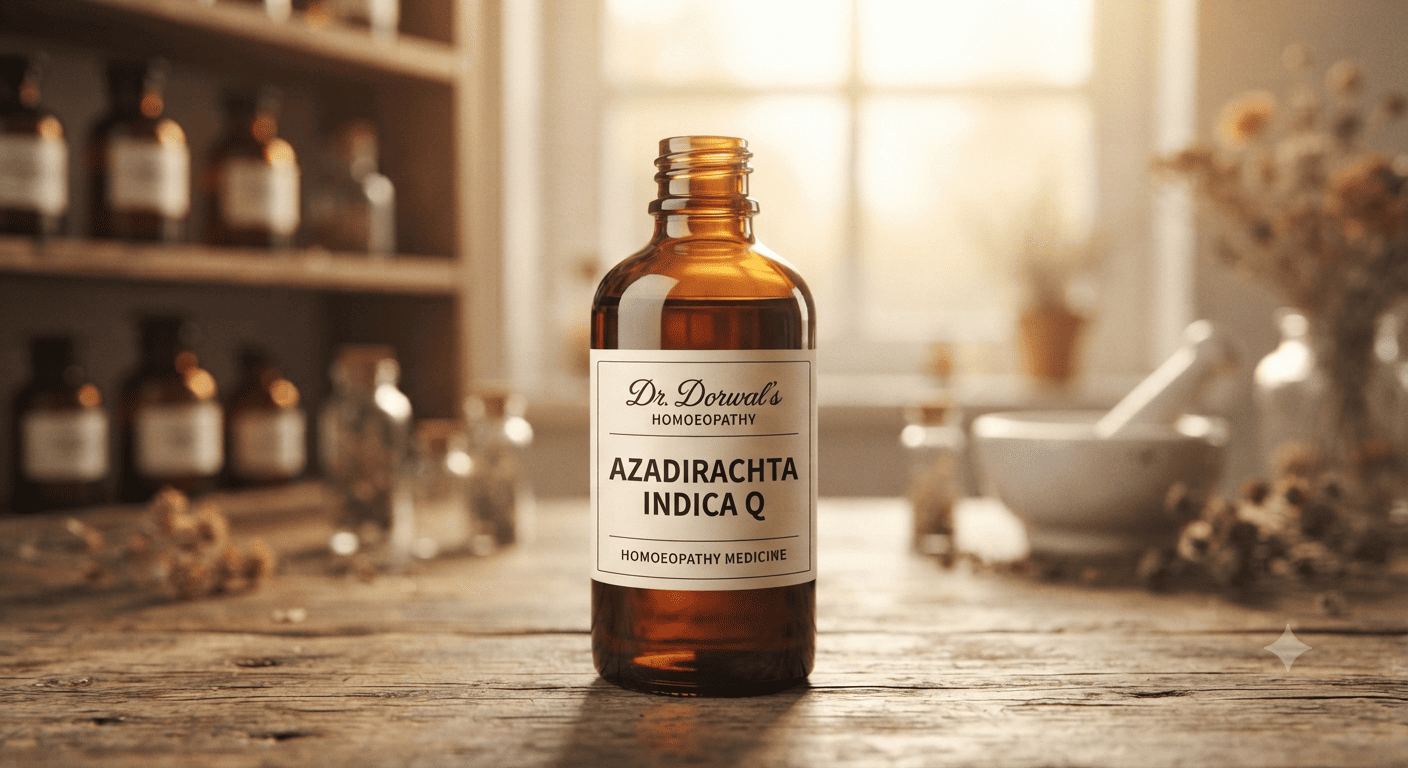
Azadirachta Indica, commonly known as Neem or Margosa, is a significant botanical agent in homoeopathic repertoire. While often recognized for its traditional systemic applications, in homeopathic preprations, it is a focused remedy for specific febrile patterns and localized rheumatic disturbances.
Key Clinical Indications & Uses
Therapeutic profile of Azadirachta Indica is centered on its action during febrile states and its affinity for neuromuscular system:
- Febrile Patterns: It is specifically indicated for fevers that manifest in afternoon. These fevers are typically preceded by a slight chill and followed by a sensation of “glowing heat” in face, hands, and feet. A distinct feature is the presence of copious perspiration, particularly localized on upper part of the body.
- Rheumatic & Neuralgic Pain: It covers rheumatic pains that manifest in various parts of body, including the sternum, ribs, back, shoulders, and extremities. A hallmark sensation is heat, pricking, and aching localized in the palms, fingers, and toes.
- Cephalic & Sensory Disturbances: Patient may experience giddiness upon rising, forgetfulness, and scalp sensitivity. Ocular symptoms include burning in eyes and localized pain, particularly in the right eyeball.
Administration & Dosage
- Dose: It is generally used in Mother tincture (Q) or 30C potency.
Dr. Dorwal’s Perspective
In my clinical practice, Azadirachta Indica is a remedy that I contemplate when the febrile cycle follows a very specific afternoon timeline. Many patients present with chronic, low-grade inflammatory states that never quite “break,” and when that heat settles into the extremities—the palms and soles—I look for this remedy to modulate that internal combustion.
What I find most clinically instructive is the pricking, aching sensation in fingers and toes. It is a remedy that addresses the “periphery” of body, helping to draw the heat out of core and regulate the skin’s eliminatory function. For the practitioner, Azadirachta serves as a reminder that a fever is not just a rise in temperature, but a systemic shift in the body’s energy. When that heat is “glowing” and the upper body is drenched in sweat, this remedy helps bring the patient back to a state of equilibrium.
Disclaimer: This content is for informational purposes only. Homoeopathic medicines should be taken under the guidance of a qualified homoeopathic physician. Do not self-medicate for chronic or serious medical conditions, and always seek professional advice for any health concerns.
Frequently Asked Questions (FAQs)
Fever characteristically manifests in the afternoon, often preceded by a slight chill.
Patient experiences a “glowing” heat in the face, hands, and feet, with profuse sweating on upper body.
It is indicated for rheumatic pains that include a pricking, aching sensation in the palms, fingers, and toes.
Yes, it can cause giddiness on rising, forgetfulness, and sensitivity of the scalp.
