
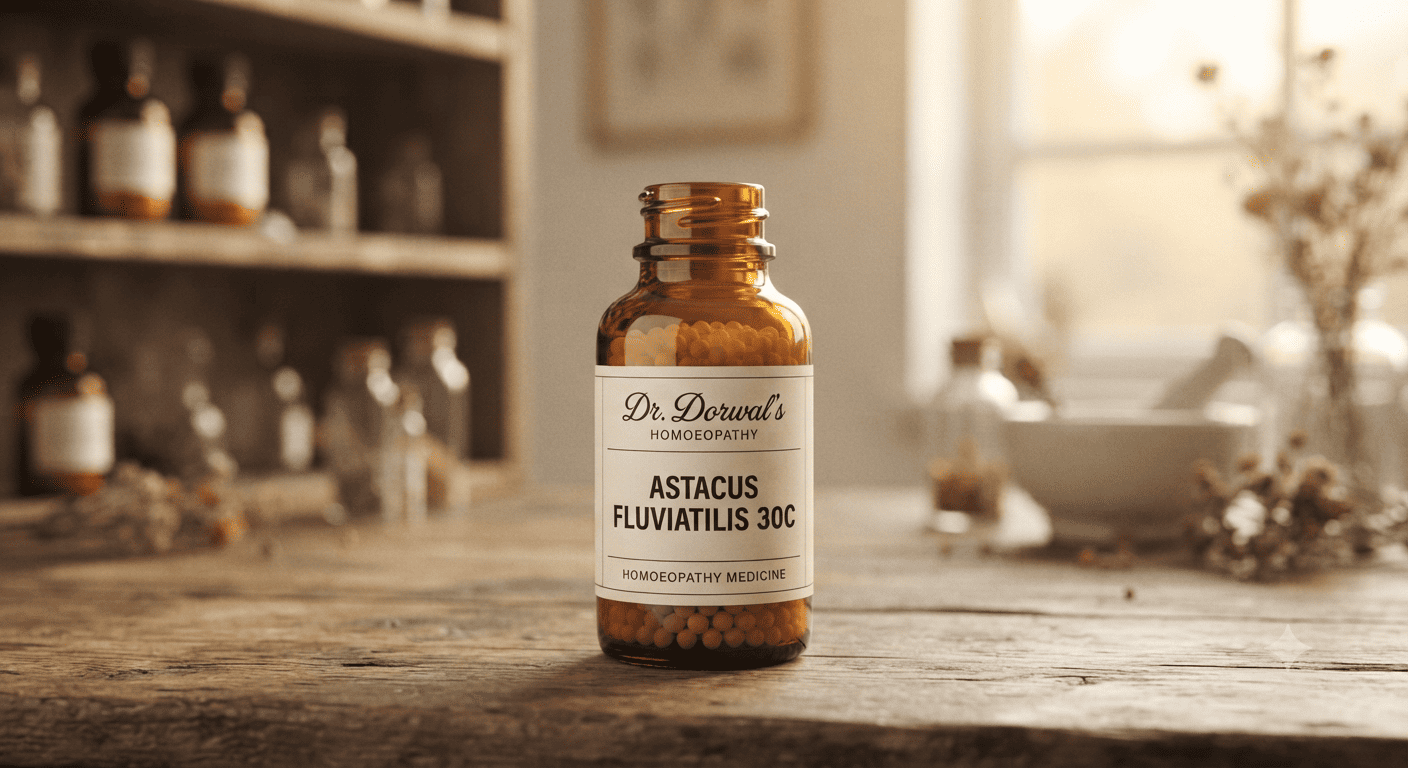
Astacus Fluviatilis, derived from common crawfish, is a specialized remedy in homoeopathic materia medica primarily recognized for its affinity for skin and hepatic system. While its clinical application is focused, it remains an intriguing study in homoeopathic approach to eruptive and inflammatory skin disturbances.
Key Clinical Indications & Uses
Therapeutic profile of Astacus Fluviatilis is centered on its ability to address acute, generalized skin eruptions and their often-linked hepatic dysfunctions:
- Urticaria (Nettle-Rash): The hallmark of this remedy is a generalized nettle-rash covering entire body, accompanied by intense itching. It is a specific consideration when this urticarial state is concurrent with liver disturbances or jaundice.
- Dermatological Pathology: It addresses crusta lactea (infantile eczema) especially when there is concurrent enlargement of lymphatic glands. It is also indicated in cases of erysipelas.
- Glandular Involvement: Beyond the lymphatic glands, it shows a specific affinity for swelling of cervical glands.
- Febrile State: Febrile picture is marked by a sensation of inward chilliness, an extreme sensitivity to cold air (worsening upon uncovering), and violent fever accompanied by a significant headache.
Administration & Dosage
- Dose: Clinical literature suggests the utilization of 3C to 30C potency depending on the depth and acuteness of case.
Dr. Dorwal’s Perspective
In the practice of homoeopathy, we often find remedies that occupy a very narrow, yet highly effective, niche. Astacus Fluviatilis is one such remedy; its profile is almost entirely defined by skin and liver. It provides a unique lens through which to view the connection between hepatic congestion and sudden manifestation of generalized nettle-rash.
That said, as a physician, I prioritize remedies where clinical evidence is robust and broad, and I have found that my current practice protocols are well-served by other established agents for urticaria and hepatic support. Consequently, I do not utilize Astacus Fluviatilis in my active clinical practice. However, I believe that an understanding of its specific affinity for crawfish-derived symptom complex—particularly when jaundice and nettle-rash appear in tandem—is a valuable piece of knowledge for any practitioner building a comprehensive differential diagnostic toolkit.
Disclaimer: This content is for informational purposes only. Homoeopathic medicines should be taken under the guidance of a qualified homoeopathic physician. Do not self-medicate for chronic or serious medical conditions, and always seek professional advice for any health concerns.
Frequently Asked Questions (FAQs)
Its skin symptoms, specifically generalized urticaria (nettle-rash) that may be associated with liver affections or jaundice.
Patient experiences a sense of “inward chilliness,” is highly sensitive to air, and suffers from a violent fever coupled with a headache.
It is indicated for enlargement of lymphatic glands, particularly the cervical glands, often alongside skin conditions like crusta lactea.
