
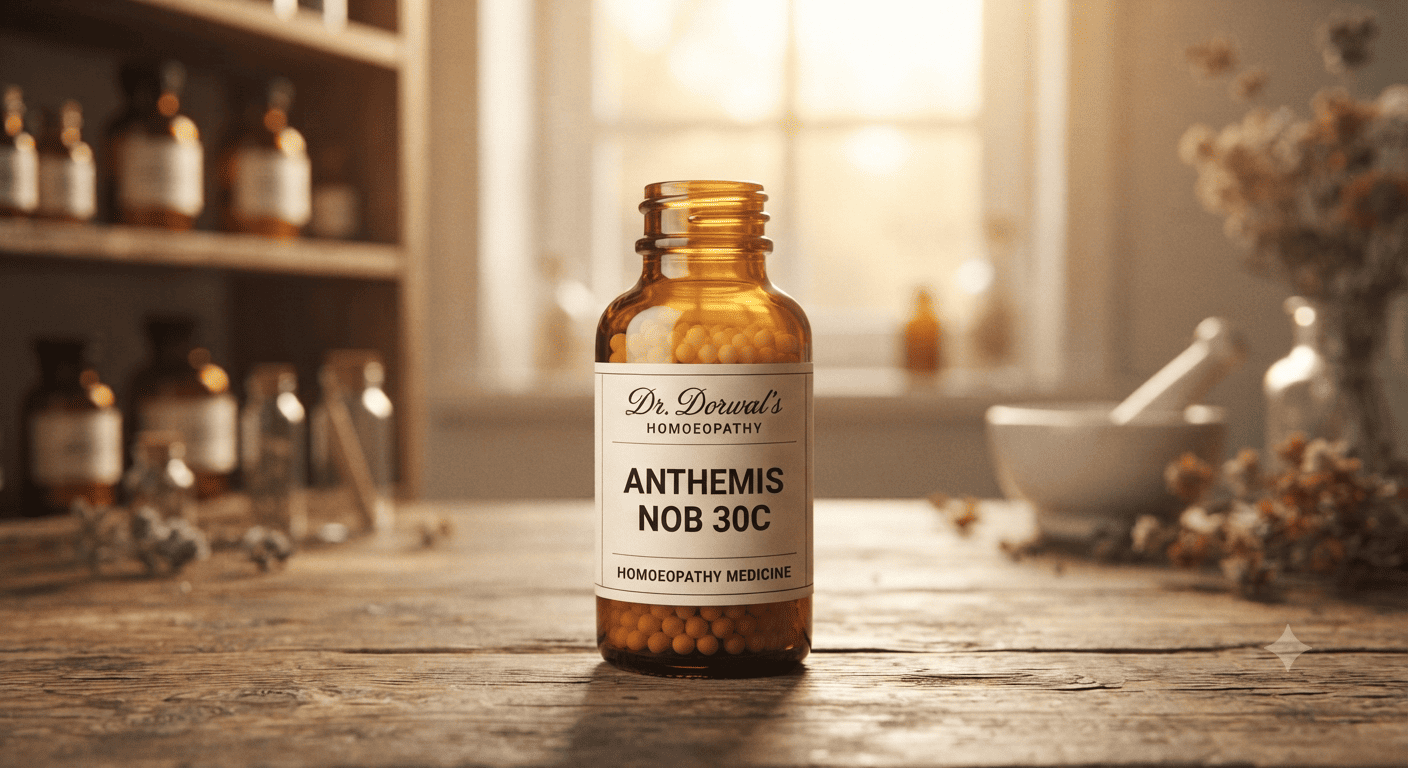
Anthemis Nobilis (Roman Chamomile) is a remedy of significant restorative value, closely related to the well-known Chamomilla. While it shares some of its relative’s sensitivity, Anthemis Nobilis is uniquely distinguished by its specific affinity for localized digestive coldness, hepatic tension, and sensitive, reactive mucous membranes.
Key Clinical Indications & Uses
Therapeutic profile of Anthemis Nobilis is defined by a distinct sensitivity to environmental temperature and a tendency toward congestive, chilly states:
- Digestive and Hepatic Sensitivity: It is indicated in cases of gastric disturbance characterized by a sensation of internal coldness. Patients often report aching in the liver region accompanied by griping and a chilling sensation that radiates from abdomen into the legs.
- Respiratory Reactivity: It addresses catarrhal states marked by abundant lachrymation, frequent sneezing, and the discharge of clear, watery fluid from the nose. These symptoms are characteristically worse indoors. Throat feels raw and constricted, and the patient may suffer from a tickling cough that is aggravated by the heat of a room.
- Urogenital and Rectal Affections: Anthemis is noted for a sensation of bladder distension and frequent, urgent urination. It also covers pain along spermatic cord, which may feel full or varicosed. Anus-related itching, often associated with white, putty-like stools, is a noted clinical feature.
- Temperature Sensitivity: Patient is notably sensitive to cold air and cold objects, yet they also display skin symptoms—such as itching on the soles of the feet—that are reminiscent of chilblains or general cold-weather vulnerability.
Administration & Dosage
- Dose: In clinical practice, it is typically utilized in 30C potency for optimal results.
Dr. Dorwal’s Perspective
In clinical practice, Anthemis Nobilis is a remedy I reserve for the patient who is “deeply chilly.” When I see a patient whose digestive distress is not just painful, but is accompanied by a literal, icy sensation in the abdomen that seems to spread downward, I find Anthemis to be an incredibly helpful support.
What fascinates me about this remedy is its sensitivity to the environment. We often look for remedies that are worse from cold, but Anthemis presents a more complex picture where the patient is sensitive to cold but also suffers when indoors—a paradoxical reactivity that often defines the chronic case. It is a gentle remedy, but one that effectively grounds a nervous system that has become hyper-reactive to temperature changes. For the practitioner managing long-standing, nagging coryza or unexplained abdominal chilliness, Anthemis is an essential addition to your clinical toolkit.
Disclaimer: This content is for informational purposes only. Homoeopathic medicines should be taken under the guidance of a qualified homoeopathic physician. Do not self-medicate for chronic or serious medical conditions, and always seek professional advice for any health concerns.
Frequently Asked Questions (FAQs)
While related, Anthemis has a more specific focus on hepatic aching, internal abdominal chilliness, and a distinct sensitivity to being indoors.
Coryza with watery discharge and lachrymation, worse indoors, with a tickling cough that worsens in a warm room.
Bladder distension, frequent urination, and a feeling of fullness or varicosis along the spermatic cord are the key urogenital indications.
30C potency is generally utilized in practice.
