
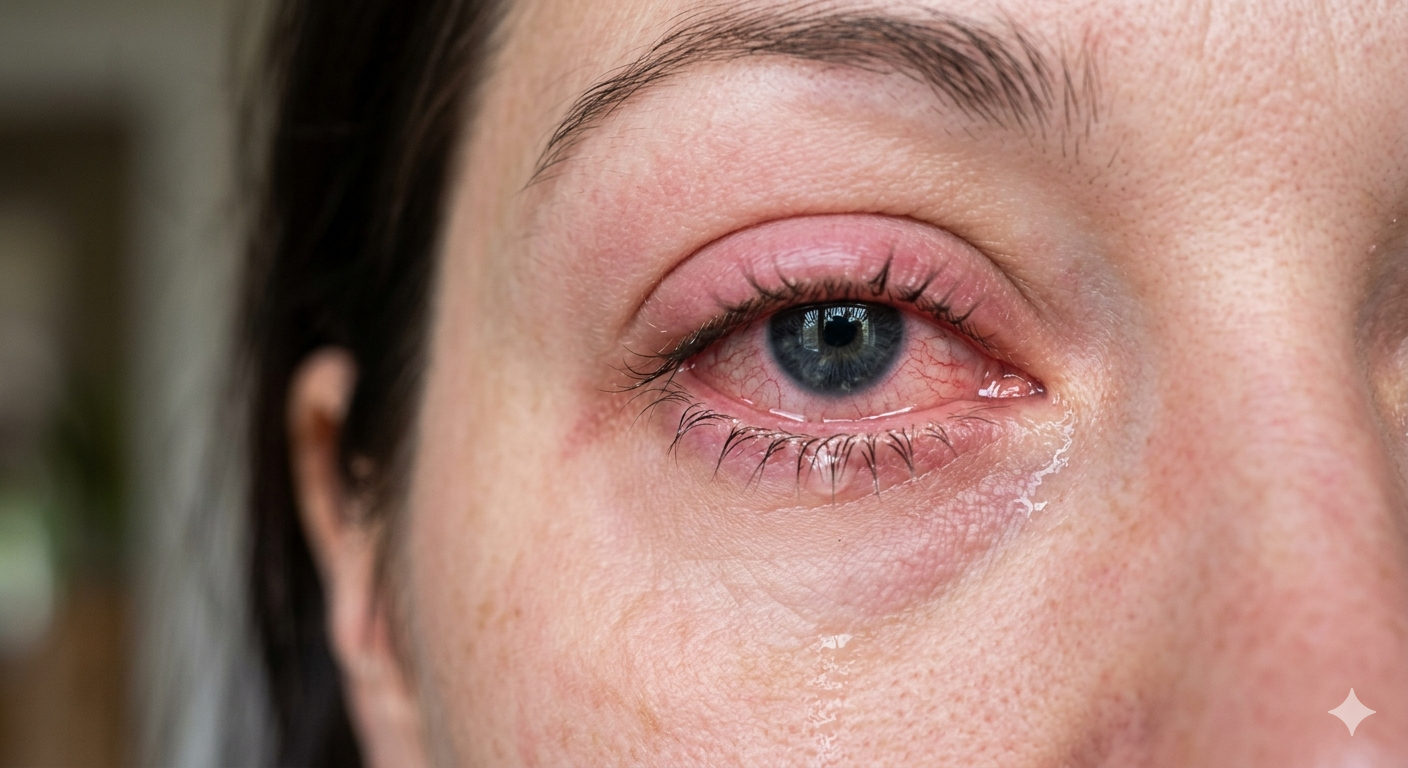
Allergic conjunctivitis is the inflammation of the conjunctiva—the transparent membrane that lines the inner eyelid and covers the white part of the eyeball. The eyes appear pink because the small blood vessels within the conjunctiva become inflamed and visible. Conjunctivitis may be caused by bacterial, viral, or allergic reactions, but it is important to note that pure allergic conjunctivitis is not contagious. Although pink eye can be highly irritating, it rarely affects vision permanently.
Definition
Allergic conjunctivitis is an inflammation of the conjunctiva due to allergic or hypersensitivity reactions, which can be either immediate (humoral) or delayed (cellular) in nature. Notably, the conjunctiva of the eye is ten times more sensitive to allergens than the skin.
Signs and Symptoms
- Intense itching and a burning sensation in the eyes.
- Watery, mucoid, or stringy discharge from the eyes.
- Mild photophobia (sensitivity to light) and occasionally blurred vision.
- Hyperemia and chemosis, which give a swollen, “juicy” appearance to the conjunctiva.
- Mild papillary reaction, which may be observed on the palpebral conjunctiva (the inner lining of the eyelids).
- Edema (swelling) of the eyelids is often present.
Causes
The immune system produces histamine to defend the body against perceived environmental threats. Common irritants that trigger this hypersensitivity reaction include:
- Dust mites
- Pollen grains
- Mold spores
- Animal dander
- Chemical scents (such as detergents and perfumes)
- Certain ophthalmic medications (eye drops)
Classification
Allergic conjunctivitis is classified into several distinct clinical entities based on the severity of signs, symptoms, and underlying predisposing factors:
1. Simple Allergic Conjunctivitis
This is a mild, non-specific allergic response characterized by itching and a mild papillary reaction. It presents as an acute or subacute urticarial reaction following the exposure of the ocular surface to airborne allergens. It primarily exists in two forms:
- Seasonal Allergic Conjunctivitis (SAC): A response to seasonal allergens like grass and tree pollens. It is frequently associated with hay fever and is also known as hay fever conjunctivitis.
- Perennial Allergic Conjunctivitis (PAC): A year-round response to perennial allergens such as house dust, animal dander, and dust mites.
2. Vernal Keratoconjunctivitis (VKC)
Vernal keratoconjunctivitis is a recurrent, bilateral, interstitial, and self-limiting allergic inflammation of the conjunctiva that shows a periodic seasonal incidence. While its pathogenesis is characterized by Th2 lymphocyte alterations, common predisposing factors include:
- Age and Sex: Typically affects individuals aged 4 to 20 years and is significantly more common in boys than girls.
- Season: Most prevalent during the summer; therefore, its traditional name “spring catarrh” is largely a misnomer.
- Atopic History: Associated atopic manifestations—such as eczema or asthma—are present in 40% to 75% of patients.
- Family History: A family history of atopy is found in 40% to 60% of cases.
3. Atopic Keratoconjunctivitis (AKC)
This chronic condition is closely associated with atopic dermatitis (eczema). Most patients are young adults, with a strong male predominance. Histologically, an abundance of mast cells and eosinophils are found infiltrating the conjunctival epithelium.
4. Giant Papillary Conjunctivitis (GPC)
Giant papillary conjunctivitis is characterized by the formation of large papillae on the palpebral conjunctiva measuring greater than 1 mm in size. Also known as mechanically induced papillary conjunctivitis, it is a localized allergic response to a physically rough surface or foreign deposit (such as contact lenses or ocular prostheses). Its pathology stems from a combination of mechanical trauma and a subsequent immune response to surface antigens.
5. Phlyctenular Keratoconjunctivitis
This condition is characterized by nodular lesions (phlyctenules) on the conjunctival or corneal epithelium. It occurs as a localized delayed hypersensitivity response to various microbial or environmental antigens.
6. Dermatoconjunctivitis
Dermatoconjunctivitis involves both the conjunctiva and the skin of the eyelids, often extending to the surrounding facial areas. It is typically a delayed hypersensitivity response to topical drugs, cosmetics, or specific chemicals.
Complications
While most cases of allergic conjunctivitis are mild, severe or untreated variants (like VKC or AKC) can lead to serious complications. Patients may experience intense pain, permanent loss of vision, severe photophobia, and corneal ulceration.
Diagnosis
Diagnosis is predominantly clinical, based on typical signs and symptoms. However, physicians may also utilize the following diagnostic evaluations:
- Exudate Analysis: Detecting an abundance of eosinophils in the eye discharge.
- Conjunctival Cytology: Scrapings demonstrating a lymphocytic response alongside masses of eosinophils.
- Allergy Testing: Skin prick tests to identify specific causative environmental allergens.
Management of Allergic Conjunctivitis
General management involves breaking the cycle of allergen exposure and soothing the ocular surface:
- Allergen Avoidance: Identifying and avoiding specific triggers.
- Cold Compresses: Applying cold compresses to reduce swelling and provide immediate relief from itching.
- Protective Eyewear: Wearing wraparound sunglasses/goggles to mitigate photophobia and shield eyes from airborne pollens.
- Environmental Control: Staying in air-conditioned environments to filter out airborne allergens.
- Climate Adjustment: Moving from hot, humid regions to cooler climates is sometimes recommended for severe, recalcitrant cases.
- Nutritional Support: Consuming a high-protein diet supplemented with vitamins A, C, and D to support overall immune health.
Important Clinical Note: If the pathology of the eye progresses beyond simple conjunctivitis, or if there is severe pain or vision changes, evaluation and treatment by an ophthalmologist must be sought without delay.
Homoeopathic Approach to Treatment
Homoeopathy is a system of medicine based on the principle of “Similia similibus curentur” (like cures like). In cases of allergic conjunctivitis, a homeopath selects a remedy based on the “totality of symptoms,” which evaluates the patient’s mental and emotional state alongside their physical complaints to stimulate the body’s self-healing mechanisms.
Some well-indicated homoeopathic medicines include:
- Pulsatilla nigricans: Often indicated when the conjunctiva is highly injected (red) and accompanies thick, bland, green-or-yellow discharges. It is frequently selected based on a constitutional profile (e.g., mild disposition, thirstlessness, relief in open air).
- Aconitum napellus: A primary acute remedy in the materia medica. It is indicated when conjunctivitis develops suddenly, particularly after exposure to cold, dry winds or following the irritation of an ocular foreign body.
- Argentum nitricum: Indicated for marked inflammation where the inner canthi (corners of the eyes) are intensely red and secrete a purulent, thick discharge. It is utilized in both acute and chronic presentations.
- Belladonna: Well-regarded for sudden, violent acute eye ailments. It is prescribed when the eyes are bright red, hot, and throbbing, accompanied by severe photophobia but notably lacking thick discharge. Symptoms tend to appear suddenly and subside just as quickly.
- Euphrasia officinalis (Eyebright): One of the most frequently used ocular remedies. It targets severe burning, acrid lacrimation (watery discharge that excoriates the skin of the cheeks) paired with marked redness, itching, and eyelid swelling.
- Silicea terra: While primarily utilized in cases of blepharitis (eyelid inflammation) and infections of the tear ducts, it is used in conjunctivitis to address thick, yellow, crusty discharges and to help the body clear persistent foreign body sensations.
Conclusion
“Allergic conjunctivitis” is an inclusive umbrella term that encompasses several distinct clinical variations. While Type I hypersensitivity mechanisms drive the majority of these conditions, both IgE and non-IgE mediated pathways are actively involved in ocular allergies. Conventional localized therapies offer effective symptomatic relief to manage the cases of allergic conjunctivitis, where as holistic homoeopathic approach aims to restore internal physical, mental, and emotional balance to address the patient’s underlying hypersensitivity by working on inner balance of the patient at physical, mental and emotional level. (1,2,3,4)
