
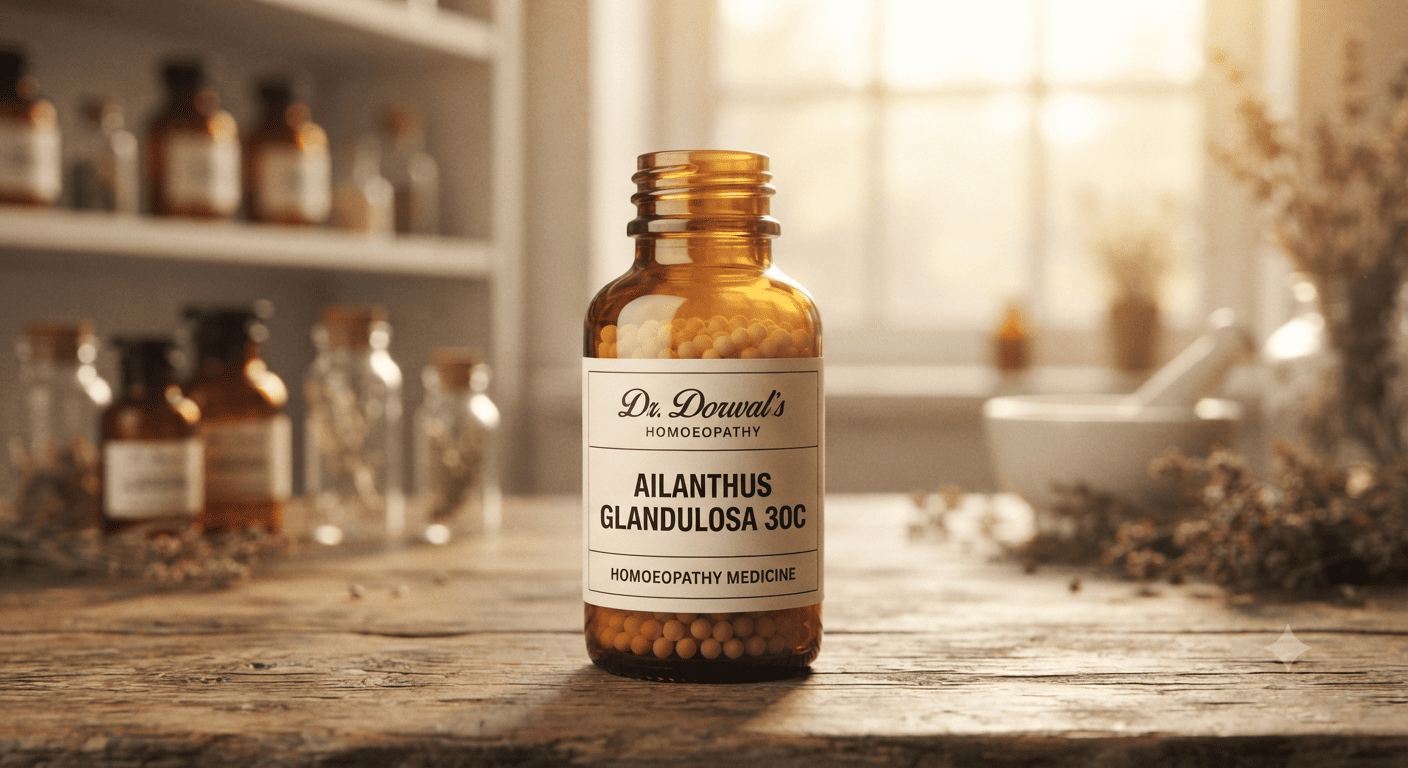
Ailanthus Glandulosa, or Chinese Sumach, is a profoundly powerful homoeopathic remedy indicated for states of extreme constitutional collapse. Its sphere of action is defined by a rapid disorganization of blood, manifesting in malignant, low-type infectious diseases where the vital forces are severely depleted.
Key Clinical Indications & Uses
Therapeutic profile of Ailanthus is characterized by “adynamia”—a profound lack of force or vitality—and a tendency toward rapid malignancy:
- Malignant Infectious States: It is a vital remedy for low-type fevers, malignant scarlatina, diphtheria, and streptococcal infections. The hallmark presentation is one of extreme torpor, stupor, and prostration.
- Characteristic Lividity: A distinguishing feature of Ailanthus is the color of the affected tissues. The face appears dusky, often described as dark as mahogany; the throat is swollen, purple, or livid; and the skin displays a miliary, livid rash that may appear patchy.
- Haemorrhagic and Ulcerative Tendencies: Mucous membranes are prone to ulceration and haemorrhage. Patients often present with sordes (crusts) on the teeth, a dry, brown tongue, and a thin, ichorous, bloody nasal discharge.
- Throat and Respiratory Distress: Throat is edematous and dusky red, with pain upon swallowing that extends to the ears. Voice may become hoarse or croupy, and breathing is frequently hurried and irregular.
Administration & Dosage
- Dose: In clinical practice, it is typically utilized in 30C potency.
Dr. Dorwal’s Perspective
In clinical practice, Ailanthus Glandulosa is a remedy that I categorize as a “life-saving” agent in the context of acute, malignant pathology. When I encounter a patient in a state of semi-consciousness, with a dusky, mahogany-colored face and a throat that looks alarmingly swollen and purple, Ailanthus immediately comes to mind.
It is the remedy for the “low” state—where system is failing to react, pulse is weak, and the patient is sinking into a stupor. While we often focus on the eruptive diseases, I have found its action on the haemorrhagic diathesis and systemic adynamia to be incredibly precise. It is a remedy that demands deep clinical vigilance; it is meant for the acute, the malignant, and the desperate, where its ability to reorganize the vital force can truly turn the tide of a clinical emergency.
Disclaimer: This content is for informational purposes only. Homoeopathic medicines should be taken under the guidance of a qualified homoeopathic physician. Do not self-medicate for chronic or serious medical conditions, and always seek professional advice for any health concerns.
Frequently Asked Questions (FAQs)
Primary characteristic of Ailanthus are “adynamia,” or profound loss of strength, accompanied by dusky, livid, or purple-colored swellings and skin eruptions.
It is used in low-type fevers, malignant scarlet fever, diphtheria, and any infection presenting with systemic collapse.
Throat is inflamed, edematous, and dusky red or purple, often with pain that radiates to the ears.
30C potency is most commonly employed in practice.
