
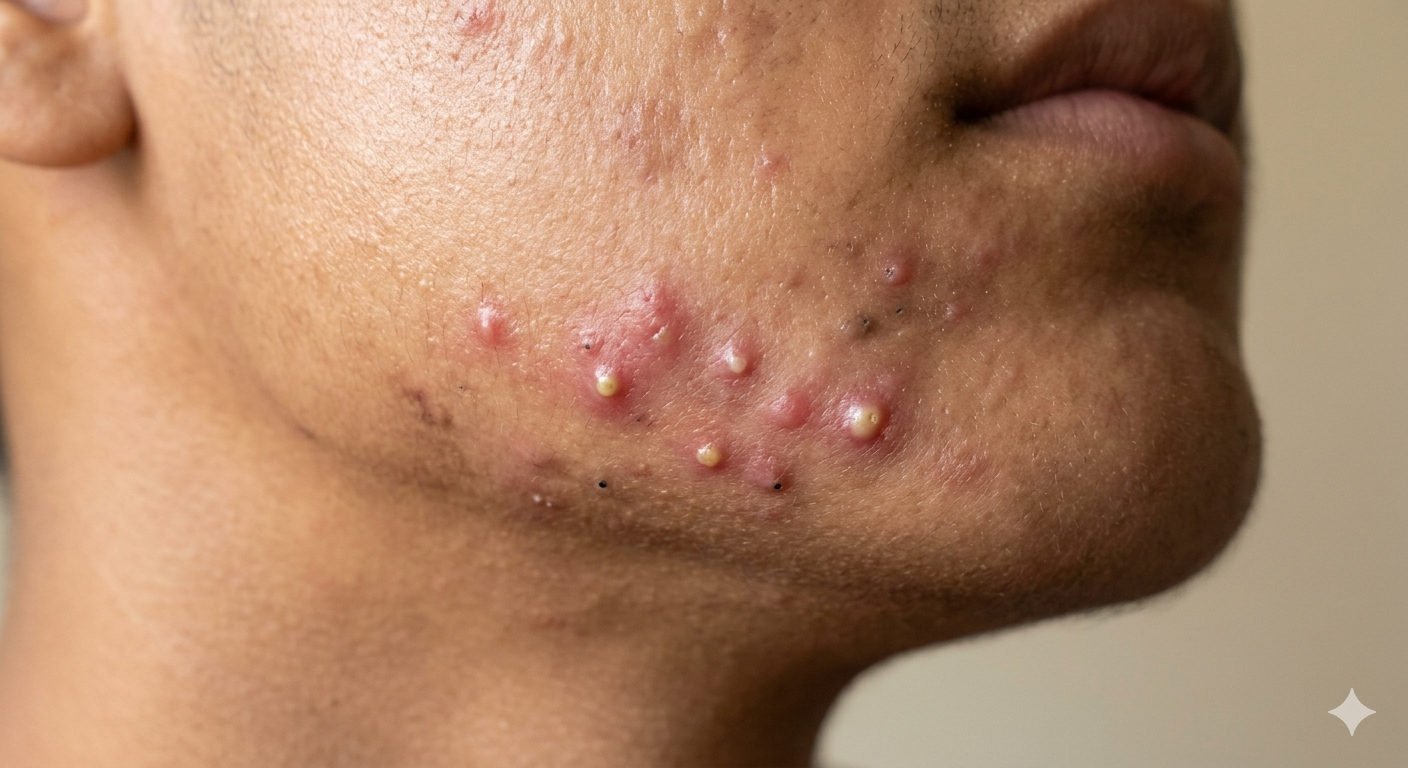
Acne vulgaris is a self-limiting, common inflammatory disorder found predominantly in adolescents in both sexes. Lesions are more commonly seen on the face, upper chest, and upper back. Studies show that acne vulgaris has a lifetime prevalence of approximately 85% and is associated with puberty and psychological disturbances such as poor self-image, depression, and anxiety. In fact, these factors lead to a negative impact on the quality of life. (1)
Pathophysiology: What Happens?
Acne vulgaris is a result of the overactivity of the oil (sebaceous) glands in the skin that become plugged and inflamed. What happens? Hair follicles are blocked with dead skin, bacteria, oil, and keratin, resulting in the formation of comedones. Further, these comedones may present with blackheads and whiteheads upon the deposition of skin pigment melanin. In advanced stages, comedones become infected and may result in pustular acne. (2)
Signs and Symptoms
Acne vulgaris shows mild to severe clinical features depending upon the severity of the condition. Clinical features include:
- Whiteheads, appearing in closed plugged pores.
- Blackheads, appearing in open plugged pores.
- Papules, which are small red bumps.
- Pustules, with pus at their tips.
- Nodules or cystic lesions, which are painful lumps beneath the skin.
Causes of Acne Vulgaris
Several factors are involved in the causation of acne vulgaris. Causes include:
- Hormonal Changes: Studies show that acne vulgaris occurs from the hypersensitivity of the sebaceous glands to androgens. Androgen is a hormone produced by the adrenal glands. Excessive secretion of androgen hormones triggers the development of acne. In addition, growth hormone (GH), insulin-like growth factor 1 (IGF-1), insulin, corticotropin-releasing hormone (CRH), and glucocorticoids are also associated with the development of acne vulgaris. (3, 4)
- Medications: Long-lasting intake of several medications such as lithium, steroids, and anticonvulsants may disrupt hormonal balance and cause acne vulgaris.
- Sunlight Exposure: Some patients are hypersensitive to the UV rays of sunlight. The condition worsens during the summer months, and acne vulgaris is aggravated by exposure to sunlight. (5)
- Endocrine Disorders: Endocrine disorders such as polycystic ovary syndrome (PCOS), Cushing’s syndrome, congenital adrenal hyperplasia, androgen-secreting tumors, and acromegaly play a role in the development of acne vulgaris. (6)
Other Contributing Factors: Emotional stress, using greasy cosmetics, menstruation in females, high humidity, genetics, dietary factors, and many more can also cause acne vulgaris.
Classification (Grading) of Acne Vulgaris
Acne vulgaris is classified into four grades:
- Grade 1 – It includes comedones, either open or closed. Here, open comedones develop due to the plugging of the pilosebaceous opening by sebum on the skin surface, whereas closed comedones develop due to keratin and sebum plugging the pilosebaceous orifice below the skin surface.
- Grade 2 – It is the typical course of pustular acne, where inflammatory lesions are present.
- Grade 3 – It is the chronic inflammatory acne grade, where pustules are formed.
- Grade 4 – It is the most disastrous and advanced stage, featuring maximum inflammation where pustules form nodules and cysts.
Risk Factors
There are many factors that contribute to the development or increase the risk of acne vulgaris. Risk factors include:
- Age – Hormonal changes play a vital role in the development of acne vulgaris. If you are at the age of puberty (around 14 to 20 years old), you have a higher chance of developing acne vulgaris.
- Skin type – A person with oily, mixed, or neutral skin in comparison to dry skin is at a higher risk of developing acne vulgaris.
- Diet – Diet and nutrition affect the overall health of an individual. A diet rich in high glycemic index foods and fatty acids affects the sebaceous glands and increases the risk of developing acne vulgaris.
- Use of cosmetics – The use of cosmetics such as heavy creams and lotions leads to the blockage of hair follicles, which further leads to the formation of comedones.
Complications
Sometimes acne vulgaris may develop complications, such as:
- Acne scars – Acne scars may develop if you pick or squeeze your spots. You may develop ice pick, rolling, or boxcar scars. Therefore, you should avoid picking or scratching your spots.
- Post-inflammatory hyperpigmentation – Sometimes dark spots and pigmentation are left behind after an acne lesion heals. In advanced cases of acne vulgaris, you have a higher chance of developing post-inflammatory hyperpigmentation on your skin.
- Depression – Many people suffer from depression and anxiety due to cosmetic concerns and withdraw from social connections.
- Lack of self-esteem – Sometimes a person thinks excessively about the condition and loses self-confidence, even feeling poorly about themselves. (7)
How is Acne Vulgaris Diagnosed?
Doctors diagnose acne vulgaris by examining your skin. The doctor analyzes the stage of your acne based on the appearance of lesions such as comedones, pustular acne, and nodules or cysts. In women, doctors sometimes conduct ultrasound scans and blood tests to confirm underlying endocrine disorders such as polycystic ovary syndrome.
Management and Treatment of Acne Vulgaris
The management of acne vulgaris includes limiting certain foods, such as high glycemic index foods, dairy products, and oils that may cause or trigger the condition. Doctors use topical treatments, which may be used singly or in combination with systemic treatments. Topical agents include antibiotics, antiseptics, comedolytics, and keratinolytics.
In addition, regular washing of the face may reduce the occurrence of the condition. Doctors prefer soft cleansers, whereas antiseptic soaps are often not as useful because soaps can penetrate deeply into skin pores. On the other hand, people are increasingly moving toward holistic approaches to treat acne vulgaris and choosing homeopathy as a first-line choice.
Homoeopathy Approach and Medicines
Homoeopathic medications are found useful in the treatment of acne vulgaris. A series of case studies suggest a success rate of more than 80% using individualized homoeopathic treatment. Doctors prescribe a single medicine based on the patient’s individual characteristic symptoms after assessing symptomatology at physical, mental, and emotional levels. In addition, studies show that homoeopathic medicines do not have significant side effects. Doctors widely use the following homoeopathic medicines to treat acne vulgaris:
- Sulphur – It is most often indicated in this skin affection, especially if the ailments are chronic. The skin of the patient is rough and hard, producing heat and burning with itching. Acne vulgaris is associated with comedones and constipation. In addition, aggravation from water is a characteristic guiding symptom for Sulphur in skin affections. Sulphur is also indicated in cases where skin affections arise after local medications.
- Hepar sulphuris calcareum – It is best suited to people with unhealthy skin. There is a strong tendency to suppuration, which is a hallmark of Hepar sulphuris. Lesions spread through the formation of small papules around the sides of old lesions. Acne features bloody suppuration and smells like old cheese. In addition, the acne is sensitive to touch, with burning and stinging pain in the papules.
- Calcarea sulphurica – It is indicated where pimples or pustules suppurate. In fact, this medicine has a great action on suppurative processes after pus has found a vent. Discharges are yellow, thick, and lumpy, whereas pustules bleed easily upon scratching.
- Kali bromatum – It is indicated in cases where acne vulgaris is found on the face, neck, and shoulders. It is especially indicated in hyperaesthetic, nervous females. It is also useful when acne vulgaris occurs due to sexual excesses. Dr. J.H. Clarke, one of the pioneers of homoeopathy, stated that he knew of no remedy of such universal usefulness in simple acne as Kali bromatum 30. Today, it remains a widely used therapeutic medicine for acne vulgaris.
- Natrum muriaticum – It acts especially on the sebaceous glands and is very helpful in acne vulgaris. The skin is greasy and oily, affecting the hair follicles. It can be used where excessive intake of salt causes nutritive disturbances and skin affections arise.
- Antimonium crudum – This medicine is indicated when a patient presents with small red pimples on the face, acne in individuals with gastric derangements, and a thick white-coated tongue. The skin is thick, hard, and dry with pimples, vesicles, and pustules.
- Sanguinaria – It is especially suited to women with scanty menses and irregular circulation of blood. There is burning and itching in the acne lesions, and the condition is worse on the right side of the patient. Other homeopathic medicines for acne with sexual disturbances include Calcarea carbonica and Aurum muriaticum.
- Silicea terra – The acne associated with this remedy is delicate, pale, and waxy-looking, but the pus is offensive and itching is present during the day and evening. Silicea is renowned for promoting the expulsion of foreign bodies from tissues. It is also useful in cases of long-lasting suppuration and fistulous tracts, making it one of the premier remedies for suppuration alongside Hepar sulph.
Arsenicum bromatum, Aurum muriaticum, Calcarea carbonica, Calcarea picrata, Antimonium tartaricum, Berberis aquifolium, Pulsatilla, and many other homeopathic remedies can also help treat acne vulgaris based on their own peculiar symptomatology.
Conclusion
Acne vulgaris is a self-limiting leading disorder in the age of adolescence. Acne is mostly observed on the face, back, shoulder, and chest. In most of the cases, the disease condition is resolved by itself due to hormonal changes at the time of puberty. Nowadays, globally, the disorder is a cosmetic issue, which sometimes leads to anxiety and depression in younger ones. People are in search of treatment with the least number of side effects and homoeopathy medicines solve their problem. In fact, you can choose homoeopathy for your adolescence disorders including acne vulgaris. It is gentle, safe, and resolves your ailments holistically. Evidence-based studies show that choosing a classical homoeopathy approach, where doctors prescribe a single remedy, is effective and treated more than 80% of cases of acne vulgaris without any side effects, whereas sometimes conventional treatment leads to a number of side effects and your condition becomes worse.
