
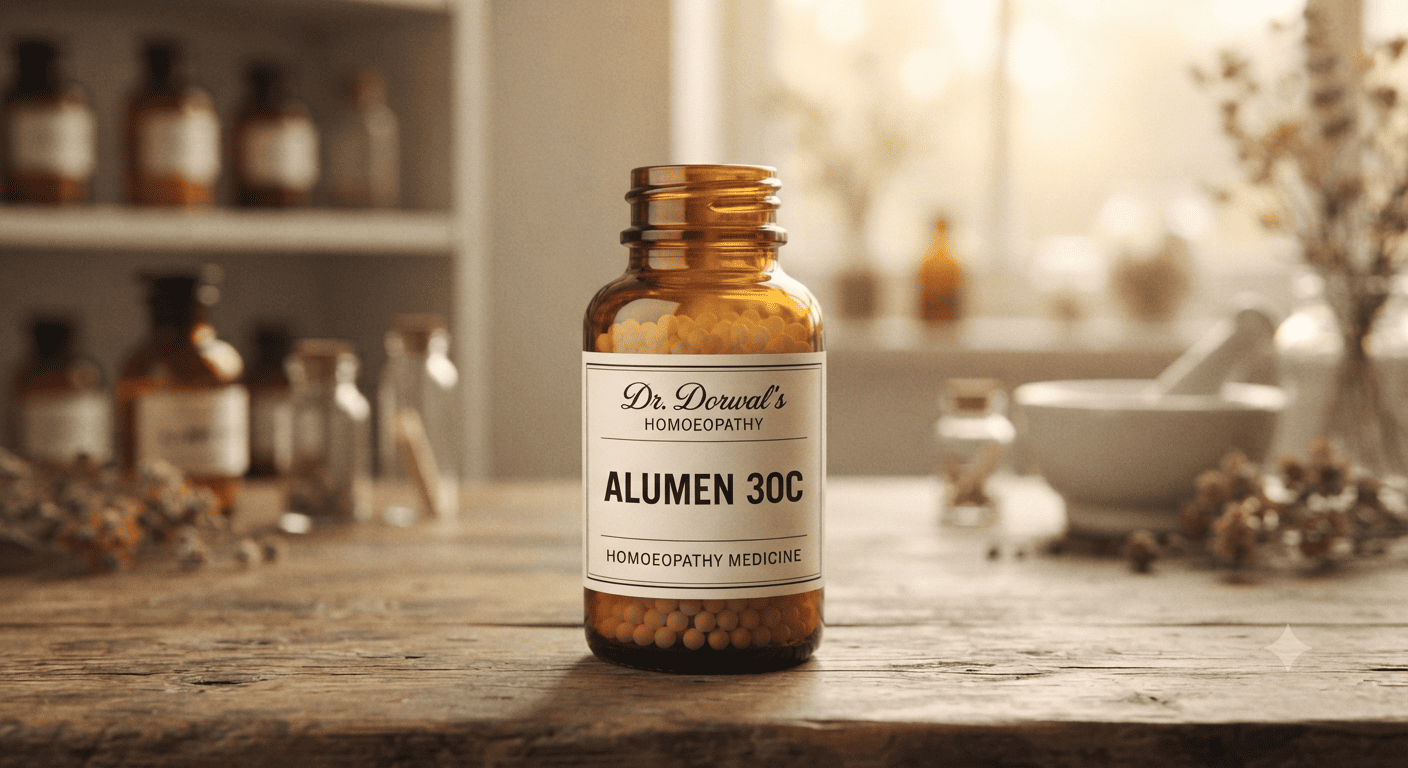
Alumen (Common Potash Alum) is a profound constitutional remedy characterized by a distinct tendency toward induration (hardening) of tissues and a generalized state of muscular weakness bordering on paralysis. It is a vital instrument for the physician when dealing with conditions where tissues have lost their elasticity and have begun to harden, whether in the glands, the rectum, or the epithelial structures.
Key Clinical Indications & Uses
Therapeutic profile of Alumen is defined by its action on both structural integrity of tissues and functional capacity of the musculature:
- Obstinate Constipation & Rectal Pathology: Alumen is a premier remedy for the most severe forms of constipation. The rectum suffers from a lack of expulsive power, leading to an aggravated state where patient may have no desire for stool for days. When it finally occurs, stool is passed in hard, marble-like masses, often followed by long-lasting smarting and rectal soreness. It is also indicated for rectal haemorrhages, particularly in the context of typhoid.
- Induration & Neoplastic Tendencies: It possesses a marked affinity for hardening tissues. It is indicated for scirrhus of the tongue, induration of mammary glands or cervix, and ulcers that present with a characteristic hardened base. It is a remedy to be considered in cases of epithelioma and chronic glandular inflammation.
- Catarrhal & Throat Affections: It is highly effective for “throat-types” in the elderly, where every cold settles in throat. Symptoms include a relaxed, red, and swollen pharynx, dysphagia (specifically for liquids), and a sensation of constriction in the esophagus.
- Muscular Weakness: Reflecting a paralytic weakness of the muscles throughout the body, Alumen is indicated for general debility and a constricted sensation around the limbs.
Administration and Modalities
- Modalities: Symptoms are generally worse from cold, with the notable exception of the Alumen headache, which finds relief from cold applications.
- Dose: In my practice, I have found efficacy across a wide spectrum, from 30C to higher potencies. The very highest potencies have also proven remarkably efficacious in deeply ingrained constitutional cases.
Dr. Dorwal’s Perspective
In my daily clinical practice, Alumen is a remedy I rely upon for those “hardened” cases that seem to resist more common constitutional remedies. When I encounter a patient with an indurated gland, or a rectum that has simply lost the “will” to function, Alumen offers a unique physiological pivot.
What is particularly impressive is its action on elderly patient with chronic bronchial catarrh—those individuals whose systems seem to have dried and hardened over time. It is a remedy of precision; it does not just soften the tissue, but it seems to restore a degree of tone to the paralyzed musculature. It is a testament to the versatility of our Materia Medica that a substance as common as Alum can act with such depth to address some of our most stubborn, pathologically dense cases.
Disclaimer: This content is for informational purposes only. Homoeopathic medicines should be taken under the guidance of a qualified homoeopathic physician. Do not self-medicate for chronic or serious medical conditions, and always seek professional advice for any health concerns.
Frequently Asked Questions (FAQs)
It is uniquely indicated for the induration (hardening) of tissues, whether in glands, ulcers, or mucous membranes.
It is “aggravated”—characterized by a complete lack of desire for stool, followed by the passage of marble-like masses and subsequent long-lasting soreness.
It addresses relaxed, swollen mucous membranes, often with a feeling of constriction and difficulty swallowing liquids.
It specifically addresses the “bronchial catarrh of the aged” and systemic muscular weakness that accompanies the aging process.
