
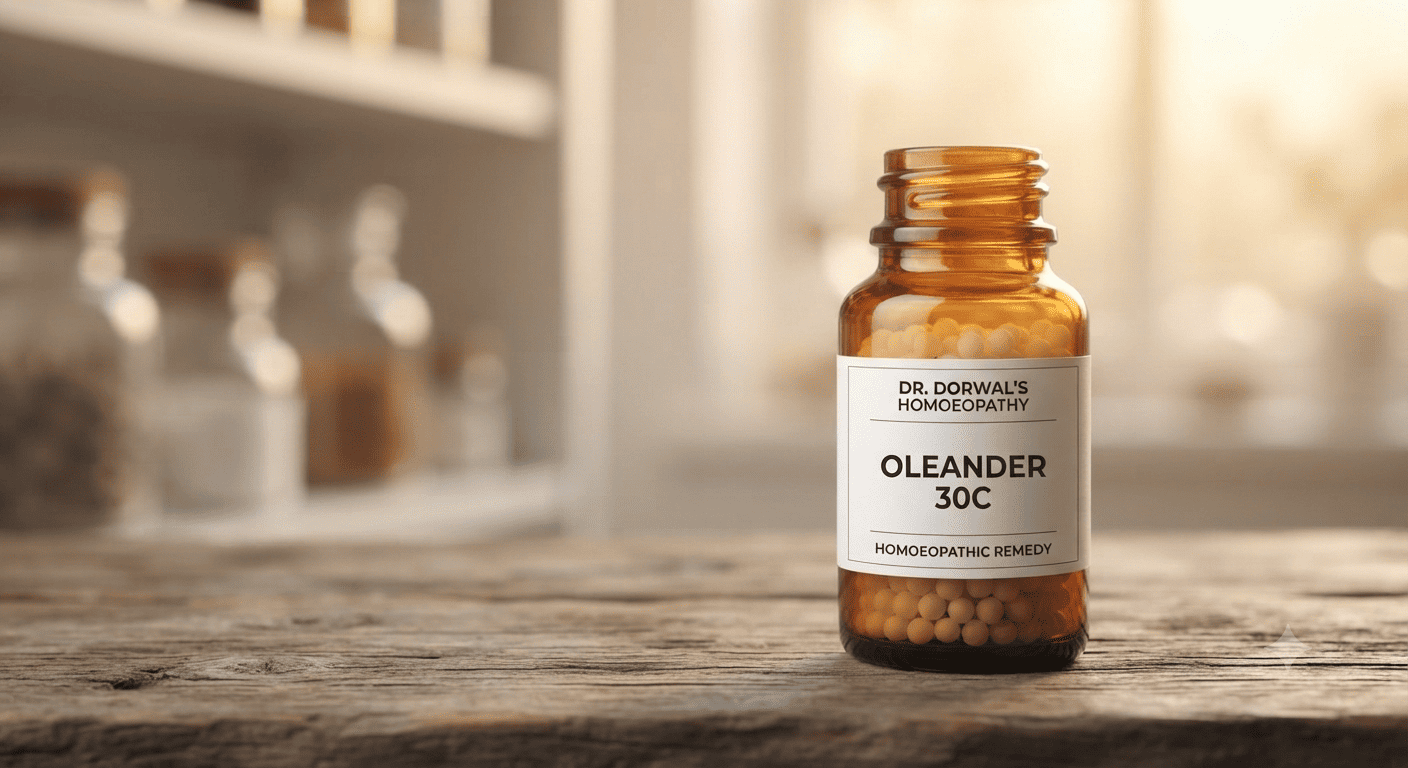
Oleander, commonly known as Rose-laurel, is a potent remedy in the homoeopathic pharmacopoeia, noted for its significant influence on the skin, heart, and central nervous system. It is uniquely indicated for paralytic states accompanied by cramp-like contractions and various manifestations of nervous exhaustion, offering deep-acting support where physical and mental vigor have become compromised.
Key Benefits & Uses
Oleander is primarily indicated for states involving diminished sensory perception, motor disturbances, and hypersensitive skin conditions:
- Neurological & Motor Support: It addresses paralytic conditions, including hemiplegia and weakness of the lower limbs, often with associated cramp-like contractions of the upper extremities. It is also indicated for cases of difficult articulation and chronic weakness in the joints and feet.
- Mental & Cognitive Clarity: It is a valuable remedy for states of weak memory, slow perception, and melancholy, often accompanied by stubborn constipation. It helps alleviate mental dullness and indolence.
- Dermatological Health: It is highly effective for violent, itching eruptions that are scurfy, bleeding, or oozing. It specifically targets sensitive skin that develops soreness or chapping from the slightest friction, as well as humid, fetid spots behind the ears and on the scalp.
- Cardiovascular & Respiratory Regulation: It provides support for palpitations, a sensation of weakness or emptiness in the chest, and asthmatic oppression that worsens when lying down. It is also associated with improvements in pulse regularity and the management of edema.
- Gastrointestinal Regulation: It addresses canine hunger with hurried eating, yet a lack of true appetite. It is indicated for borborygmus, fetid flatus, and undigested stools that may pass involuntarily when emitting flatus.
Administration & Therapeutic Modalities
- Potency Selection: Clinical practice suggests the use of potencies ranging from the 30C to the 200C.
- Modalities: Symptoms are characteristically worsened by undressing, resting, and the friction caused by clothing.
Dr. Dorwal’s Perspective
In my clinical practice, Oleander is a specialized remedy for the patient whose nervous system seems to have lost its ‘animal heat’ and vitality. When I encounter patients suffering from painless paralysis, cold extremities, or a deep sense of mental sluggishness—often coupled with a very sensitive, eruptive skin condition—I turn to Oleander to modulate these systemic imbalances. I find it particularly useful for those who experience ‘bursting’ head pains and vertigo when looking down or focusing on an object. Its ability to restore warmth to cold, stiff limbs while simultaneously calming the cardiac and respiratory distress caused by nervous exhaustion makes it an essential component of my constitutional approach to chronic, multi-systemic illness.
Disclaimer: This content is for informational purposes only. Homoeopathic medicines should be taken under the guidance of a qualified homoeopathic physician. Do not self-medicate for chronic or serious medical conditions, and always seek professional advice for any health concerns.
Frequently Asked Questions (FAQs)
It is primarily used for paralytic conditions, weakness of the lower limbs, and skin eruptions that are violent, itching, and highly sensitive to friction.
It is indicated for weak memory, slow perception, and a state of melancholy, often associated with a sense of mental dullness or inability to think clearly.
Yes, it is indicated for palpitations and a feeling of emptiness or oppression in the chest, and it has a historical reputation for helping to regulate pulse and reduce edema in certain cardiac conditions.
Symptoms are often aggravated by undressing, rest, and the friction of clothing, which should be considered during the management of the patient’s condition.
