
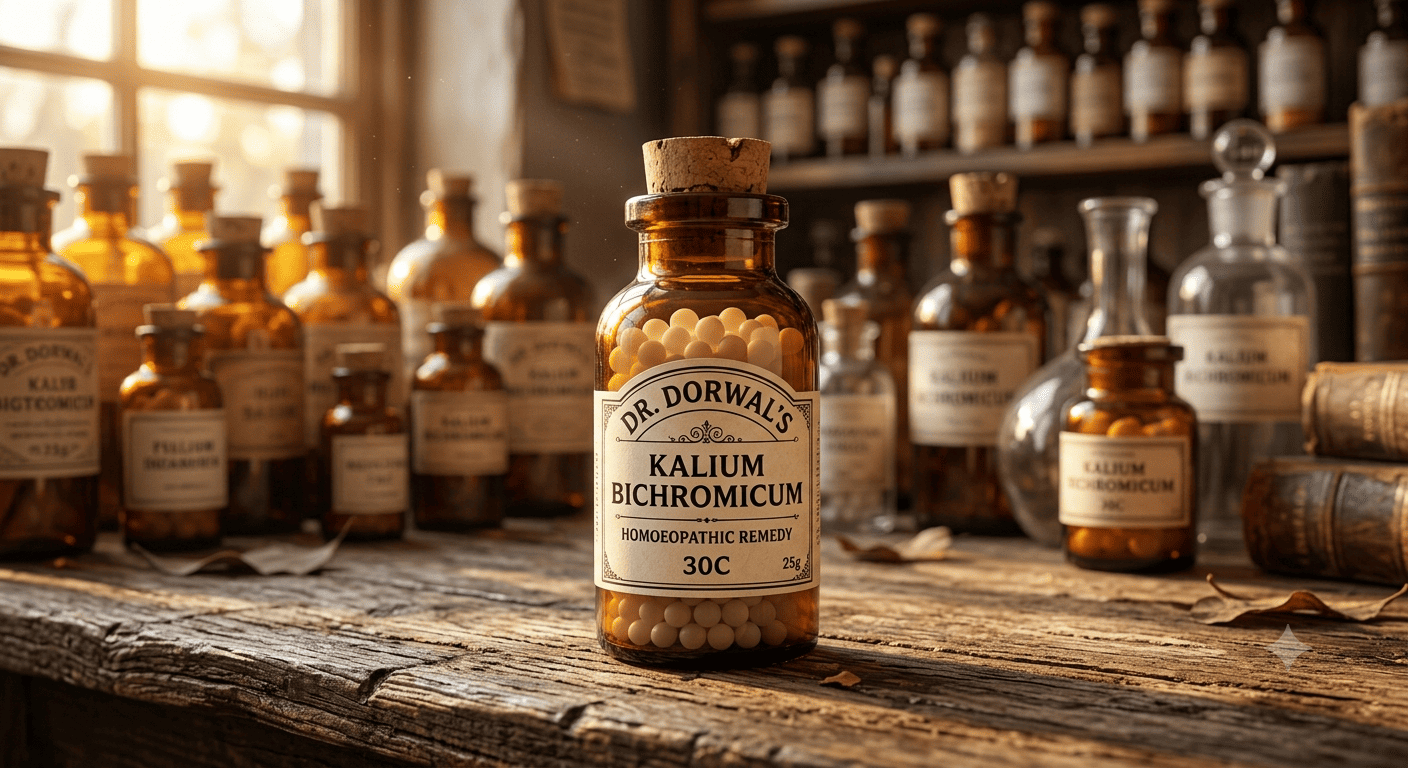
Kalium Bichromicum (Bichromate of Potash) is a significant homoeopathic agent with a profound affinity for the body’s mucous membranes, fibrous tissues, and skeletal system. Its clinical application is primarily distinguished by its ability to resolve conditions characterized by the production of tough, stringy, and viscid secretions, as well as its unique action on subacute inflammatory states.
Clinical Indications & Benefits
In clinical practice, Kalium Bichromicum is utilized for several specific scenarios:
- Respiratory & Catarrhal Conditions: Highly indicated for chronic catarrh of the pharynx, larynx, and nose, where the hallmark symptom is the discharge of tough, ropy, greenish-yellow, or elastic mucus. It is also employed in cases of membranous croup, hoarseness, and metallic, hacking coughs that produce glutinous, stringy expectoration.
- Gastrointestinal Disorders: Clinically useful for gastritis, gastric ulcers, and the sensation of a heavy load in the stomach immediately after eating. It addresses conditions like jelly-like stools, dysentery, and abdominal pain that appears shortly after a meal.
- Rheumatoid & Musculoskeletal Pain: Indicated for migratory pains that shift rapidly from one location to another, often affecting the bones and joints. It is specifically useful for rheumatic stiffness, joint crackling, and pain in the loins or sciatica.
- Ocular & Nasal Affections: Frequently prescribed for supra-orbital neuralgia, ulcers on the cornea, and chronic inflammation of the frontal sinuses that results in a “stopped-up” sensation.
- Skin & Dermatological Ulcerations: Utilized for skin conditions including acne, papular eruptions, and deep-seated ulcers with “punched-out” edges and tenacious exudation.
Administration & Therapeutic Modalities
- Potency & Dosage: Practitioners typically employ 30C or higher. Lower preparations should not be stored for extended periods.
- Clinical Observation: The hallmark of this remedy is its modality: symptoms are generally better from heat but worse in the morning, during hot weather, and upon undressing. Patients often present with a history of catarrhal, syphilitic, or scrofulous tendencies.
Dr. Dorwal’s Perspective
In my clinical practice, Kalium Bichromicum is my preferred remedy for the “stringy and stubborn” phase of illness. When a patient presents with thick, ropy mucus that they struggle to hawk up, or joint pains that migrate like lightning across their body, I look to this medicine to provide structural relief. It is particularly effective for the patient who suffers from recurrent “stopped-up” feelings in the sinuses or chronic gastric sluggishness. It serves as a vital tool for stabilizing mucous membrane integrity when the inflammation has moved beyond the violent acute stage and settled into a persistent, subacute pattern.
Disclaimer: This content is for informational purposes only. Homoeopathic medicines should be taken under the guidance of a qualified homoeopathic physician. Do not self-medicate for chronic or serious medical conditions, and always seek professional advice for any health concerns.
Frequently Asked Questions (FAQs)
The hallmark guiding symptom is the production of tough, stringy, viscid, and ropy mucus, which can be greenish-yellow in color.
Yes, it is highly regarded for wandering rheumatic pains that shift rapidly from one location to another and for joint stiffness accompanied by crackling.
Symptoms are characteristically better from heat, while they are aggravated by cold weather (in some cases), beer, mornings, hot weather, and the act of undressing.
Yes, it is indicated for chronic inflammation of the frontal sinuses, characterized by a feeling of fullness at the root of the nose and an inability to breathe through the nose.
