
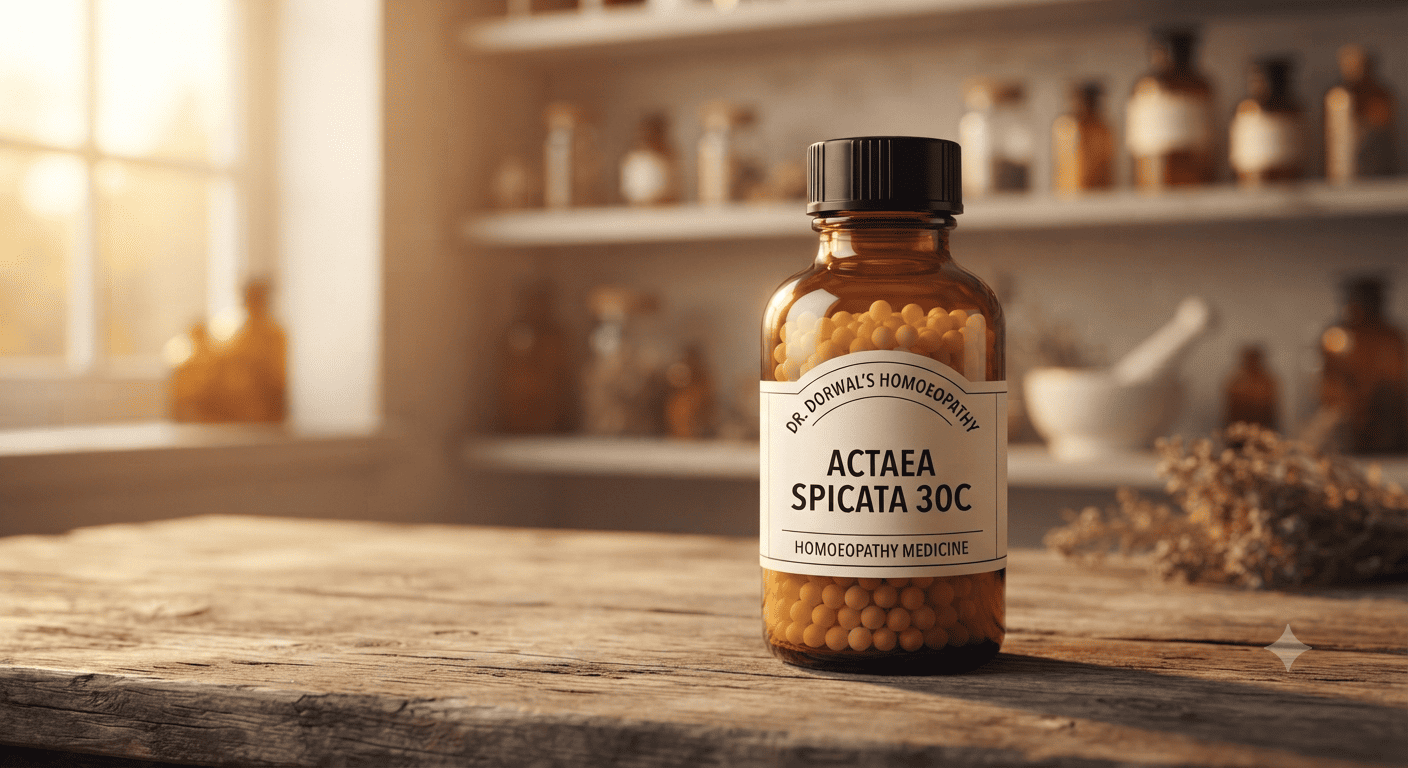
Actaea Spicata, commonly known as Baneberry, is a distinguished homoeopathic remedy with a profound affinity for rheumatic conditions, particularly those manifesting in the small joints. It is a vital agent in cases characterized by tearing, tingling pains and spasmodic symptoms that affect the skeletal and cardiovascular systems.
Key Clinical Indications & Uses
Therapeutic profile of Actaea Spicata is highly specialized, offering support for specific, often painful, inflammatory and spasmodic states:
- Rheumatic Affections of Small Joints: This is a hallmark of the remedy. It is indicated for intense, tearing pains in the wrists, fingers, ankles, and toes. These joints often become swollen, red, and hypersensitive to the slightest motion or touch.
- Cardiovascular and Hepatic Pulsations: Patients may report a sensation of pulsations occurring throughout the entire body, with a focus on the liver and renal regions. It is also indicated for cardiovascular spasms and feelings of suffocation.
- Neurological and Head Symptoms: Mentally patient is easily startled and prone to fearful states. Headaches are often tearing or throbbing in nature, frequently extending from the crown to the area between the eyebrows.
- Digestive and Respiratory: It addresses cramp-like pains in the stomach and epigastrium, often accompanied by difficult breathing and a sense of sudden exhaustion after eating or talking. Respiratory symptoms include shortness of breath, particularly when exposed to cold air or when lying down at night.
Administration, Modalities & Dosage
- Modalities: Symptoms are characteristically worse from touch, motion, and exertion.
- Dose: In clinical practice, it is typically utilized in 30C potency.
Dr. Dorwal’s Perspective
In my clinical practice, Actaea Spicata is my go-to remedy when a patient presents with “small joint” rheumatism. If a patient comes in with a swollen, red, and painful wrist that worsens with the slightest movement, I immediately consider this remedy. Beyond musculoskeletal impact, I find its ability to soothe the cardiovascular spasms and pulsations—what I often describe as a “systemic nervous tension”—to be highly effective. It is a remedy that bridges the gap between physical joint pain and the internal, spasmodic reactions of the body, offering a comprehensive approach to what might otherwise be a very localized and persistent complaint.
Disclaimer: This content is for informational purposes only. Homoeopathic medicines should be taken under the guidance of a qualified homoeopathic physician. Do not self-medicate for chronic or serious medical conditions, and always seek professional advice for any health concerns.
Frequently Asked Questions (FAQs)
It is primarily indicated for rheumatic pains affecting the small joints, such as the wrists, fingers, and ankles.
The pain is typically described as tearing and tingling, and it is made significantly worse by any motion or touch.
Yes, patients often experience confusion, fearfulness, and an tendency to be startled easily.
It is generally prescribed in 30C potency.
