
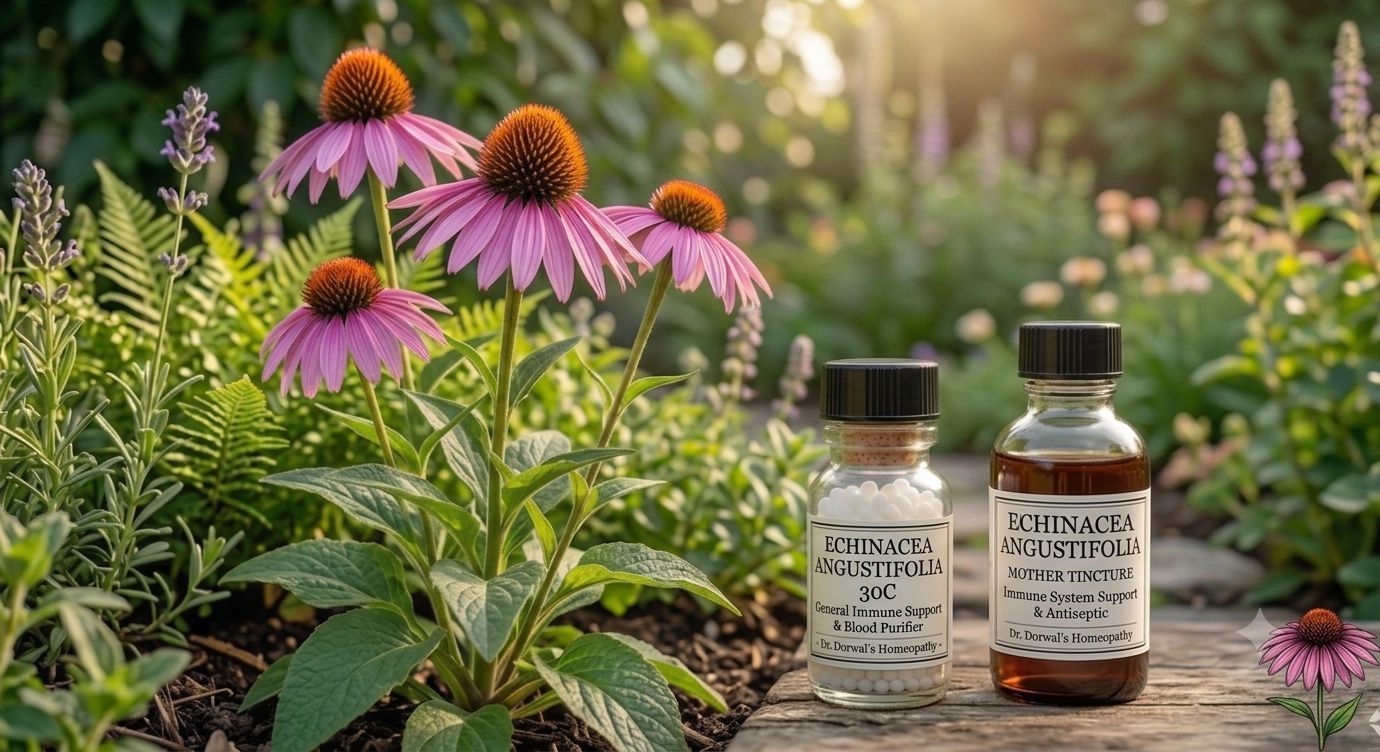
Echinacea Angustifolia, commonly known as the narrow-leaved purple coneflower, stands as one of the most venerated botanical agents within the homoeopathic and naturopathic traditions. While modern herbalism often focuses on its ability to stimulate the immune system, homoeopathy views Echinacea through the lens of “zymotic” diseases—conditions characterized by toxic blood states, septicemia, and a profound breakdown of the body’s resistance to pathogenic invasion. Unlike a simple stimulant, Echinacea acts as an “alterative,” a remedy that cleanses the blood and restores the vitality of the lymphatic system, allowing the body to overcome overwhelming infection.
Key Benefits: A Systemic Purifier
Echinacea is fundamentally indicated when there is a tendency toward tissue decay, ulceration, or blood poisoning. Its clinical utility extends across several domains:
- Septic States & Blood Poisoning: his remedy is highly regarded for treating states characterized by systemic toxicosis or the feeling of “blood contamination.” It is clinically indicated for severe inflammatory conditions, including carbuncles, deep-tissue abscesses, and gangrenous ulcerations. By regulating the body’s inflammatory response, it effectively curtails the progression of suppuration and safeguards the system against further toxic involvement.
- Lymphatic & Glandular Support: Indicated for enlarged, tender lymph nodes, particularly when they feel hot and painful to the touch. It facilitates the drainage of the lymphatic system, assisting the body in neutralizing metabolic waste and pathogenic debris.
- Immune System Modulation: It functions as a powerful prophylactic and therapeutic agent in acute infections. It is particularly valuable when the patient exhibits a “low state”—profound weakness, lethargy, and a feeling that the vitality is rapidly declining.
- Dermatological Healing: Beyond internal use, Echinacea is unparalleled for indolent (slow-healing) ulcers, insect bites, snake bites, and boils that exhibit a bluish or dusky discoloration. It acts to stop the spread of infection and encourages the regeneration of healthy tissue.
- Mucous Membrane Inflammation: Effectively treats conditions involving foul-smelling discharges, such as chronic pharyngitis, tonsillitis, or vaginitis, where the tissues appear dark or purple and are prone to bleeding.
Administration & Therapeutic Modalities
Homoeopathy employs Echinacea with strict attention to the stage of the pathology.
- Potency Selection: While low-potency (mother tincture or 3X/6X) preparations are frequently used for their direct botanical “cleansing” effect on the blood, high-potencies may be employed by a physician when the constitutional vitality requires a deeper “energetic” shift.
- Energetic Integrity: To ensure the maximum therapeutic impact, the medicine must be administered away from the influence of volatile aromatic substances. Avoid caffeine, eucalyptus, and strong essential oils for at least 30 minutes before and after dosing to ensure the “energetic imprint” remains undisturbed.
- Acute vs. Chronic: In acute poisoning or septic scenarios, frequent dosing may be required under strict supervision. In chronic lymphatic stasis, a more infrequent, constitutional approach is favored to allow the vital force to sustain the detoxification process.
Safety, Precautions & Contraindications
Echinacea is a potent agent of change for the body’s internal environment. As such, caution is required:
- Aggravations: In sensitive individuals, particularly those with autoimmune conditions, Echinacea may stimulate the immune system too vigorously. Professional oversight is mandatory for those with systemic autoimmune disorders (e.g., lupus, rheumatoid arthritis).
- The “Deep-Acting” Rule: Because Echinacea works on the blood and lymphatic system—the very transport mechanisms of the body—it should not be treated as a routine “cold supplement.” Its use should be focused on specific, symptomatic needs identified by a practitioner.
- Professional Oversight: Never substitute Echinacea for emergency medical care in cases of severe sepsis, deep infections, or high-fever emergencies. It serves as an invaluable adjunct to clinical care, not a replacement for systemic stabilization.
Dr. Dorwal’s Perspective
I favor Echinacea for patients struggling to rebound from infections, particularly those exhibiting lingering low-grade fevers, lymphatic congestion, and systemic malaise. It functions as a catalyst for detoxification rather than a simple antimicrobial, effectively clearing the ‘biological load’ that impedes natural recovery.
Furthermore, I have seen remarkable results using this remedy externally. Whether addressing indolent ulcers, stubborn boils, or infected wounds, its ability to sanitize the local terrain and stimulate rapid tissue regeneration is unmatched. By facilitating this internal and external purification, the remedy restores systemic balance and empowers the body’s innate healing mechanisms to regain control.
Disclaimer: This content is for informational purposes only. Homoeopathic medicines should be taken under the guidance of a qualified homoeopathic physician. Do not self-medicate for chronic or serious medical conditions, and always seek professional advice for any health concerns.
Frequently Asked Questions (FAQs)
No. While it has profound antimicrobial properties, in homoeopathy, it acts as an immune and lymphatic “alterative.” It supports the body’s innate mechanisms to neutralize toxins and overcome infections, rather than simply suppressing bacteria.
Yes. In the form of a homoeopathic mother tincture or diluted lotion, it is highly effective when applied to non-healing wounds, boils, or insect bites to prevent the spread of infection and promote healthy, rapid closure of the tissue.
