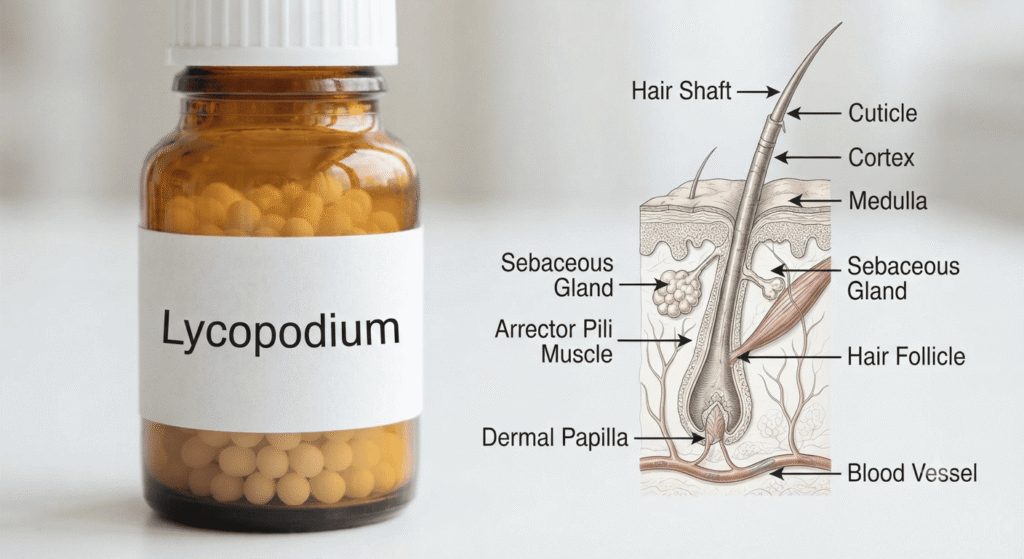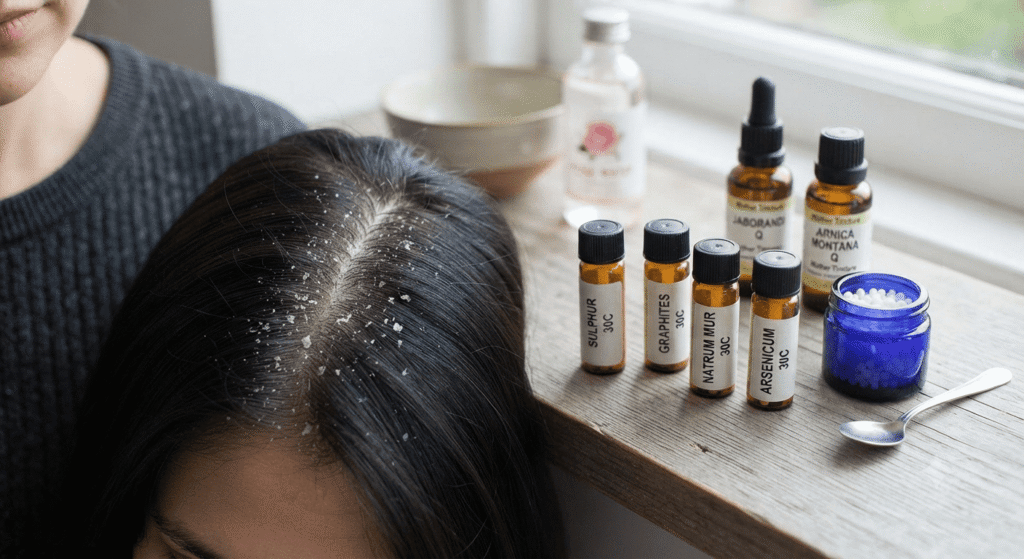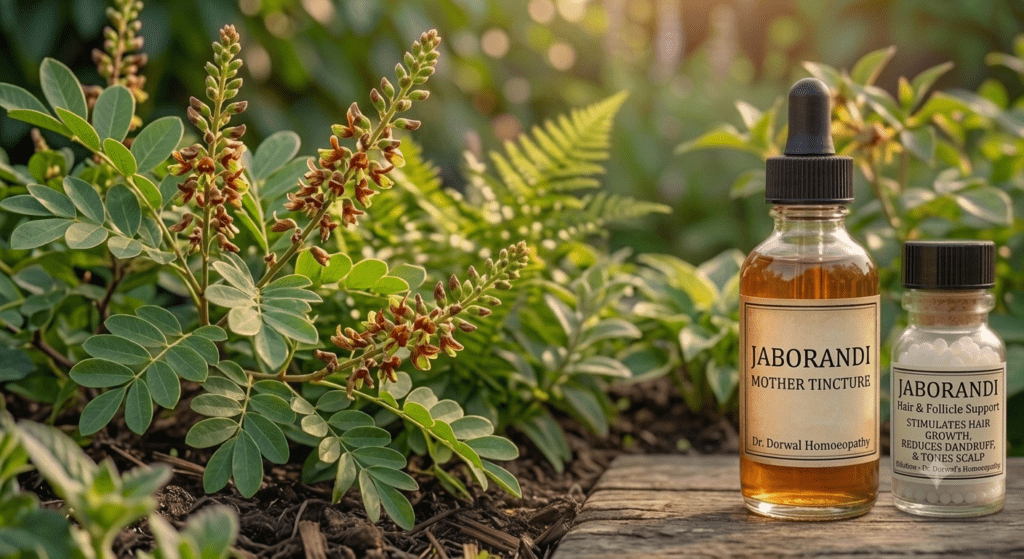
Quick Overview: In homoeopathy, commonly Jaborandi Q, Arnica Montana Q, Brahmi Q, Rosmarinus Officinalis Q, Kali Sulphuricum, Natrum Muriaticum, Lycopodium Clavatum etc. medicines are used to treat Alopecia Areata on the basis of unique symptomatology of the patient. These medicines are used in form of mother tincture, ultra diluted dilutions (Such as 30C, 200C or Higher), or Biochemic salts (Such as 3X, 6X or 12X)
Alopecia Areata is a common skin condition where immune system of the body mistakenly attacks hair follicles in areas like scalp, face, or elsewhere of the body. Commonly, it shows symptoms like sudden hair loss in small, smooth, round or oval patches. In addition, Itching, tingling, or burning in the skin before hair falls out is also noticed in clinics. Exact cause of the Alopecia Areata is still unknow, but doctors often link it with family history (Genetics), environmental triggers (Such as Severe physical or emotional stress, pathogens etc), nutritional deficiency and other health conditions like thyroid disease, vitiligo, diabetes, or allergies like asthma and eczema.
As a cosmetic concern, Alopecia Areata is a challenging condition among individuals. People often lose their self-confidence and emotional well-being due to visible hair patches. This is where homoeopathy offers a gentle, holistic, and effective management with addition of diet and yogic rehabilitation.
Why Homoeopathy Approaches Alopecia Areata Differently?
Homoeopathy doesn’t treat “alopecia areata” as a fixed label with one fixed prescription of medicines. It treats the person experiencing it — factoring in their physical constitution, their emotional state, and the pattern the hair loss follows. A well-selected, minimum dose of a matching remedy is used to stimulate what homoeopaths call the patient’s vital force, the body’s own regulating and healing capacity. Once that response is triggered, the body works on correcting the underlying disturbance rather than the hair loss being masked from the outside.
Homoeopathy medicines broadly fall into three categories in clinical use: mother tinctures for local stimulation or taken in drop doses, biochemic tissue salts for cellular nutrition, and deeper-acting constitutional medicines chosen from the person’s overall symptom picture. Common medicines include:
1. Mother Tinctures (Q) for Alopecia Areata
Mother tinctures are typically used as a gentle, supportive base — either applied locally to stimulate scalp circulation or taken in drop doses alongside constitutional treatment.
- Jaborandi Q: Jaborandi is one of the most widely used tinctures for alopecia. It is used in mixed form with hair oil or taken internally to stimulate blood circulation to the follicles and reduce excessive shedding. Many practitioners consider it a first-line supportive remedy while the constitutional treatment does the deeper work.
- Arnica Montana Q: It is used topically in diluted form or internally to encourage local blood flow, particularly where trauma, injury, or inflammation in the scalp tissue seems to be part of the picture.
- Emblica Officinalis Q (Amla): A classic botanical remedy rich in vitamin C and antioxidants, Amla is reached for to counter oxidative stress at the follicular level. It’s frequently used as a general tonic to strengthen the roots and delay premature greying alongside its role in alopecia care.
- Brahmi Q (Bacopa monnieri): Better known for cognitive benefits, Brahmi also has cooling properties that homeopaths use to calm scalp heat, and it’s often included when psychological stress and anxiety appear to be triggering flares.
- Rosmarinus Officinalis Q (Rosemary): It is valued for improving microcirculation, diluted rosemary tincture is used to help “wake up” follicles that have gone dormant, and is sometimes discussed alongside conventional circulation-boosting treatments for hair density.
- Cantharis Q: Indicated specifically when the bald patches come with intense itching, burning, or a fiery sensation on the scalp — Cantharis targets that acute inflammatory irritation that can cause hair to fall in bunches rather than gradually.
- Sabal Serrulata Q: Considered when hair loss appears tied to a hormonal pathway, particularly where DHT (dihydrotestosterone) sensitivity is thought to be influencing follicle health.
2. Biochemic (Tissue) Homoeopathy Medicines for Alopecia Areata
Biochemic salts work at the level of cellular mineral balance. Common Biochemic Homoeopathy Medicines include:
- Kali Sulphuricum: The primary biochemic salt reached for in hair loss, especially where there’s yellow scaling, dandruff, or shedding that just won’t let up. It supports the normal distribution of oil along the hair shaft, which in turn affects how brittle or manageable the remaining hair feels. In patients whose scalp repeatedly develops yellowish, sticky dandruff, this salt is particularly considered.
- Silicea: Often nicknamed the tissue builder, Silicea is essential where hair is thin, brittle, or simply slow to grow back after a patch clears. It is chosen to support the structural integrity of the follicle itself, not just surface shine. In patients whose nails are also weak and break easily, a Silicea case often stands out, since this remedy is associated with structural nutrition for both hair and nails.
- Calcarea Phosphorica: It is indicated where there is general debility or poor hair growth, particularly in younger patients. It supports calcium assimilation and overall scalp strength as the body rebuilds. In growing children and teenagers whose hair looks thin and weak, alongside slow bone or dental development, this salt is often considered.
- Natrum Muriaticum: Addresses the body’s water-electrolyte balance at the cellular level, and is considered when hair loss shows up alongside anaemia or a chronically dry scalp and hair texture. In patients with a history of emotional grief or suppressed sadness alongside hair loss, Natrum Mur is a well-known constitutional-cum-biochemic choice. This salt is also particularly noted in cases of hair loss around the hairline/margin area.
3. Constitutional & Deep-Acting Medicines
These are the medicines chosen after a detailed case-taking. In case taking physician looks at the patient’s overall physical build, emotional temperament, and the specific pattern that hair loss follows. These homoeopathy medicines are usually prescribed in higher potencies for a longer-acting effect on Alopecia Areata.
- Thuja Occidentalis: It is a deep-acting medicine often used when hair loss follows a vaccination, or where the case shows a tendency toward what homeopaths call a “sycotic” pattern. Sycotic pattern include overgrowths, warts, or similar skin tendencies. Thuja is a common choice for patchy alopecia that hasn’t responded to gentler measures. It is also considered in cases where the scalp has an oily, greasy texture and the patient has a history of new skin growths (such as warts or moles).
- Lycopodium Clavatum: It is frequently indicated in patchy hair loss occurring alongside digestive complaints — gas, bloating, a sluggish digestion — and in people who show early greying or thinning specifically at the crown.
- Vinca Minor: Vinca Minor is known specifically for hair that mats or sticks together and falls out in clumps rather than as fine, individual strands — a fairly distinctive marker that points homeopaths toward this remedy for stubborn, localized patches.
- Graphites: It is suited to patients with a background of skin eruptions, eczema, or thick, crusty dandruff, where the scalp itches and the remaining hair looks generally thin and lacklustre.
- Nitricum Acidum: It is used in cases where hair loss follows significant emotional stress, or a history of suppressed conditions treated aggressively with medication. It is particularly indicated when the scalp itself feels tender or painful to touch.
Beyond these, medicines like Sepia, Lachesis, Sulphur etc. are also used in regular practice. These medicines are chosen based on each patient’s individual symptom profile rather than the diagnosis alone.
How a Homoeopath Actually Chooses Between These?
In practice, matching a medicine to alopecia areata isn’t about picking whichever medicine is “famous” for hair loss. It is about noticing the details that in a patient might not think to mention. Does the scalp itch or burn, or is it simply numb where the patch is? Did the hair loss follow a stressful event, an illness, or nothing identifiable at all? Is there a family history of thyroid issues or other autoimmune conditions alongside it? These details are exactly what separates each Alopecia Areata medicine in an individual case.
Quick Comparison: 4 Commonly Used Medicines
The table below compares two mother tinctures, one constitutional dilution, and one biochemic salt discussed above — showing how differently each type of medicine works even though all four are used for the same condition.
| Medicine | Type | Key Indication | How It Works |
| Jaborandi Q | Mother Tincture | Diffuse thinning, excessive shedding, dry scalp | Stimulates blood circulation to follicles; used locally in oil or as internal drops |
| Arnica Montana Q | Mother Tincture | Hair loss after scalp trauma, injury, or tight hairstyling | Encourages local blood flow to injured or inflamed scalp tissue |
| Thuja Occidentalis | Constitutional Dilution | Stubborn patchy alopecia, especially post-vaccination or sycotic tendency | Deep-acting; addresses the underlying constitutional pattern, not just the patch |
| Kali Sulphuricum | Biochemic Salt | Yellow scaling, dandruff, persistent shedding | Supports cellular mineral balance and normal oil distribution along the hair shaft |
Dosage Guidelines of Homoeopathy Medicines for Alopecia Areata
Dosage in homoeopathy always depends on the individual case, the potency selected, and the practitioner’s judgment. The general patterns below are commonly followed by category of medicine — not a fixed prescription for any single remedy.
1. Mother Tinctures (Q) — e.g. Jaborandi Q, Arnica Montana Q
- Internal use: 5–10 drops in a little water, 2–3 times a day, usually before or after meals as advised.
- Topical use: 10–15 drops diluted into hair oil or a mild carrier oil, massaged into the scalp 1 time a day.
- Course length: Often used over several weeks to a few months alongside constitutional treatment; reviewed periodically by the practitioner.
- General note: Being low-potency, mother tinctures are considered gentler and are commonly used for daily supportive care rather than as the sole treatment.
2. Dilutions (Constitutional Medicines) — e.g. Thuja Occidentalis, Lycopodium, Vinca Minor
- Common potencies: 30C for milder, recent, or first-time cases; 200C, 1M, or higher for deeper-acting, long-standing, or constitutional use.
- Typical frequency: Lower potencies (30C) may be repeated a few times a week; higher potencies (200C and above) are usually given as a single dose or a few doses spaced days to weeks apart.
- Form: Given as medicated pills/globules placed on the tongue, or as liquid drops in water.
- General note: Higher the potency, the more spaced out and carefully supervised the dosing — these are not meant to be taken as casually or as frequently as mother tinctures.
3. Biochemic (Tissue) Salts — e.g. Kali Sulphuricum, Silicea, Natrum Muriaticum
- Common potencies: 3X, 6X, or 12X.
- Typical frequency: 3–4 tablets, 3 times a day, ideally between meals rather than with food.
- Course length: Since these act at a slow, cellular-nutrition level, they are usually taken over a longer, steady course rather than short bursts.
- General note: Considered safe for regular daily use over extended periods, as they work more like a mineral-nutrition support than an acute-acting medicine.
Clinical Note: These are general reference ranges only. Exact dosage, potency, and duration should always be individualized and confirmed by a registered homoeopath based on the patient’s case.
Supporting the Treatment: What Helps Alongside the Medicine
Homoeopathic medicines work best when the body isn’t fighting against additional stressors at the same time. Alopecia Areata is associated with lifestyle factors like diet and mental stress. A diet full of whole foods rather than supplements, with enough zinc, iron, and vitamin D coming from everyday sources like nuts, legumes, spinach, and moderate sun exposure helps to boost up physiological processes of the body. Gentle scalp care like use of wide-tooth combs, avoiding tight hairstyles, and skipping shampoos loaded with sulfates or synthetic fragrances may also help to reduce disease progress.
Since stress is a well-documented trigger for autoimmune flares. Practicing yogic exercises like Anulom Vilom or Bhramari pranayama are often recommended purely for their effect on cortisol levels. For conditions like alopecia areata—an autoimmune disorder where the body mistakenly attacks hair follicles. These breathing techniques help to calm the nervous system and suppress stress-induced inflammatory spikes. By regularly lowering cortisol and activating the body’s rest-and-repair response, yogic exercise creates a more balanced internal environment that can help to reduce flare-ups and support healthy hair follicle recovery.
Dr. Dorwal’s Perspective
When I look at alopecia areata patients in my clinical practice, I see the bald patch as only a part of the whole story. I always prefer to look at my patients in a truly holistic way. I take a detailed case history first to understand the root cause, underlying triggers, and overall constitutional picture of the patient. Often, I have observed cases where hair loss started after a stressful life event, while in others, a patient’s digestion, sleep patterns, or thyroid health told me far more about which medicine would work than the patch itself did.
That is really the deep value homoeopathy adds here. After carefully evaluating all these contributing factors, I prescribe an individualized approach combining constitutional homoeopathic medicine along with lifestyle support like yoga and diet to help calm the nervous system and manage stress. During consultation, I tell my patients that autoimmune diseases do not go away overnight. If you use the right natural approach, take the correct medicine, and stay patient, you will see steady improvements. Every case has its different story and causation so treatment results may vary may vary from person to person..
Disclaimer: This information is for educational purposes only. Homoeopathy is a highly individualized science. Please consult with a registered professional homoeopath who can assess your specific health history, constitution, and temperament before starting any of these medicines.
- Evidence- based homoeopathy: Case report of alopecia areata in an 11 year old boy
- A Case Report of Alopecia Areata Treated With Individualized Homoeopathy
- Treatment of alopecia areata with individualised homoeopathic medicines: An evidence-based case series
- Alopecia Areata Treated with Homoeopathic Preparation of Phosphorus: Two Evidence-Based Case Reports
- Alopecia areata and its homoeopathic management
- A REVIEW ON ALTERNATIVE MEDICINE USING HOMEOPATHY SYSTEM FOR TREATMENT OF LOSS OF HAIR
- Effectiveness of Homoeopathic Individualized Treatment in Reversing Alopecia Areata – A Case Report.
- A Case Report of Alopecia Areata Treated with Individualized Homoeopathy
Frequently Asked Questions
There isn’t one “best” medicine — homoeopathy picks the remedy based on the patient’s individual symptoms, triggers, and constitution. Thuja, Lycopodium, Vinca Minor, and Jaborandi are commonly used, but the right one depends entirely on the case.
Response time varies from patient to patient, but most people start noticing reduced shedding and early regrowth over a few months of consistent treatment. Since it’s an autoimmune condition, homoeopathy focuses on gradual, steady improvement rather than an overnight fix.
Yes, homoeopathy aims to regrow hair by correcting the underlying immune disturbance rather than just treating the bald patch. Many patients see gradual regrowth with the right constitutional remedy, though results depend on the severity and duration of the condition.
Alopecia areata happens when the immune system mistakenly attacks hair follicles, but the exact trigger isn’t fully known. It’s commonly linked to genetics, stress, nutritional deficiencies, and other autoimmune or hormonal conditions like thyroid disease.
Vitamin D, biotin, zinc, and iron are among the nutrients most often associated with healthy hair growth and follicle strength. A whole-food diet rich in nuts, legumes, and leafy greens is generally recommended alongside treatment rather than relying on supplements alone.
There’s no guaranteed way to stop alopecia areata completely, but managing stress, correcting nutritional gaps, and treating the underlying immune pattern with individualized homoeopathic care can help reduce flare-ups and support regrowth.