
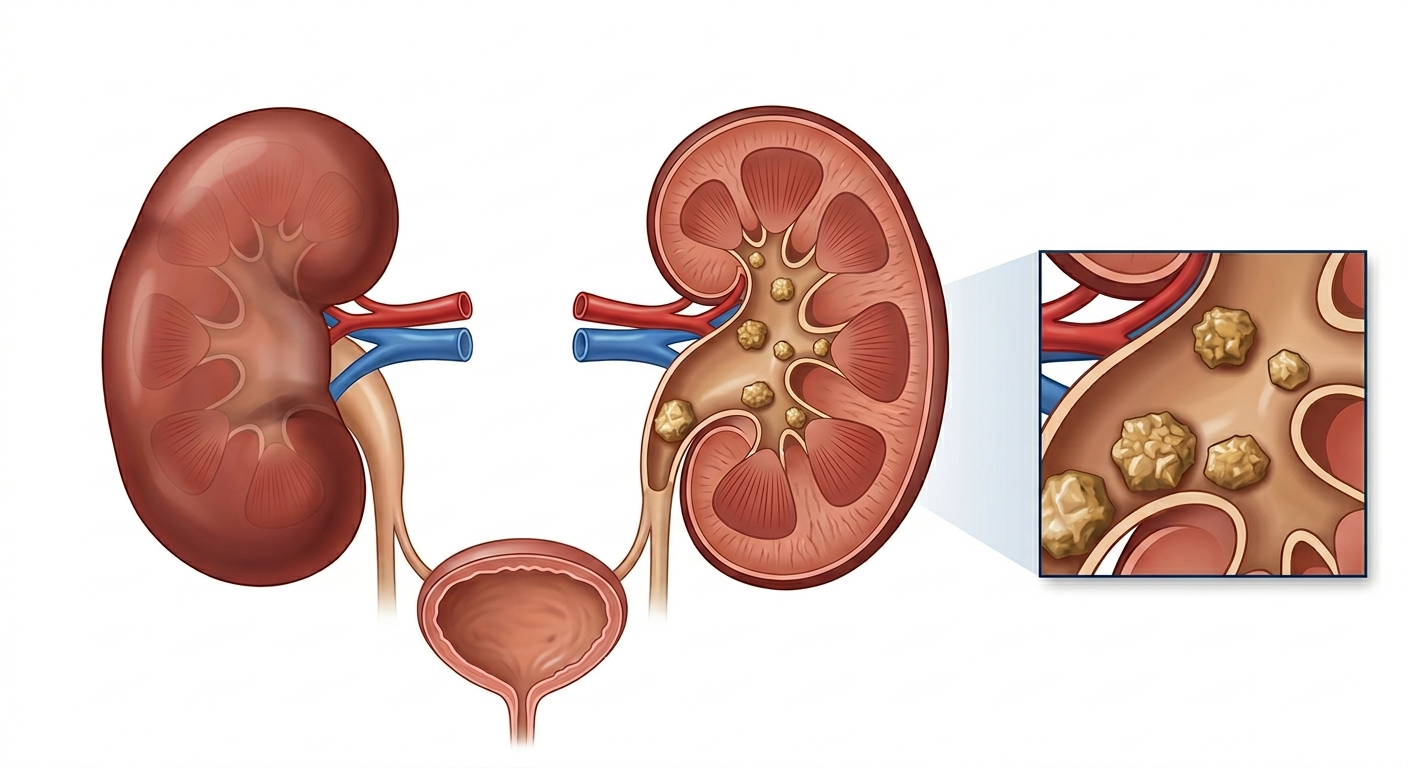
Kidney stones, also known as urinary calculi, is one of the most painful and common disorder of urinary tract. Kidney stones are formed by the crystallization of minerals and salts in the kidneys or urinary pathway. Stones can range in size from a grain of sand to the size of a golf ball. Stones remain silent within the kidneys, but when they move to urinary tract; cause urgent medical emergency. In this Homoeopathic guide, we will explore the sign and symptoms, types, risk factors, diagnostic criteria and various treatment approaches including the role of homoeopathy in cases of kidney stones.
Signs & Symptoms
Common signs and symptoms include:
- Acute Pain: Patient feel severe, sharp, cramping pain radiating from the back/side toward the lower abdomen and groin.
- Urinary Distress: An individual may experience sudden urge to urinate, burning sensation during urination (dysuria), and cloudy or foul-smelling urine.
- Haematuria: Sometimes, Presence of blood in the urine is also found.
- Obstructive Signs: In cases of urinary obstruction, patient may experience reduce urine volume, or the sensation that the bladder is not fully emptied.
- Systemic Symptoms: In advance stages, Patient may present symptoms like intense nausea and vomiting due to the severity of the pain.
Types of Urinary Calculi (Kidney Stones)
Understanding the composition of a kidney stone is vital, as it often dictates the underlying metabolic cause and the specific strategy for prevention and treatment.
| Stone Type | Characteristics | Clinical Context |
| Calcium Stones | It comprise about 75% of all stones. Typically small (<1 cm), ovoid, hard, and granular with a dark brown or jagged surface. | Often sharp-edged, causing trauma to the urinary tract. Frequently associated with high urinary calcium or oxalate levels. |
| Struvite (Mixed) Stones | Make up ~15% of stones. Often composed of magnesium-ammonium-calcium-phosphate. Generally yellow-white or grey, soft, and irregular in shape. | Often referred to as “infection stones” as they typically form in the presence of persistent urinary tract infections. |
| Uric Acid Stones | Account for about 6% of stones. Usually smooth and yellowish-brown in color. | Highly associated with high-purine diets, gout, and acidic urine environments. |
| Cystine Stones | Rare, comprising less than 2% of cases. Typically small, rounded, waxy, and yellowish. | Result from a hereditary metabolic disorder called cystinuria, where the body cannot properly reabsorb the amino acid cystine. |
| Rare Calculi | Less than 2% of cases. Includes xanthine stones or those resulting from rare metabolic or drug-induced abnormalities. | Often linked to inherited enzyme deficiencies or specific pharmaceutical side effects. |
Risk Factors & Causes
The formation of a stone is often a multi-factorial process involving genetics, metabolism, and lifestyle. Risk factors and causes include:
- Dehydration(Most Common): Insufficient water intake prevents the dilution of minerals, allowing them to crystallize.
- Dietary Habits: Diets high in sodium (which increases calcium excretion), animal proteins, and oxalates (found in spinach, nuts, and chocolate).
- Metabolic Issues: Conditions that alter the urine pH (alkaline or acidic urine) or increase the excretion of uric acid and oxalates.
- Medical History: A family history of stones, or pre-existing conditions like hyperparathyroidism or recurring urinary tract infections (UTIs).
- Medication Overuse: Excessive use of certain diuretics or uricosuric drugs.
Diagnostics & Conventional Treatment
Before determining a treatment plan, physicians utilize several diagnostic tools:
- Imaging: CT scans (non-contrast helical CT is the gold standard), ultrasounds, or X-rays (KUB).
- Laboratory Tests: Urinalysis to check for infection/crystals, and blood tests to evaluate calcium, uric acid, and kidney function (creatinine/BUN).
Treatment Approaches
Conventional Treatment Approaches
Conventional treatment approaches include:
- Medical Expulsive Therapy (MET): Using alpha-blockers to relax ureteral muscles to help pass small stones.
- Lithotripsy (ESWL): Using shock waves to break large stones into smaller pieces that can pass naturally.
- Surgical Intervention: Ureteroscopy or Percutaneous Nephrolithotomy (PCNL) for larger or impacted stones.
Homoeopathic treatment Approach
Homoeopathy operates on the principle of Similia Similibus Curentur (“like cures like”). In the case of kidney stones, the homoeopathic approach is two-fold:
- Acute Management: Addressing the immediate pain (renal colic) and facilitating the expulsion of the stone by relaxing the ureters and reducing inflammation.
- Constitutional Treatment: Identifying and correcting the underlying metabolic dysfunction or “diathesis” that leads to stone formation in the first place. This prevents the recurrence of stones by normalizing urinary pH and metabolic mineral handling.
Homoeopaths often utilize a tiered approach, combining various forms of medicine—from mother tinctures for drainage and flushing, to low-potency biochemic salts for tissue support, and high-potency dilutions for deep-seated constitutional correction.
Commonly Used Homoeopathy Medicines
1. Mother Tinctures (For Drainage, Flushing, & Anti-Lithic Action)
Mother tinctures are concentrated liquid extracts often used in drop doses to support the kidneys natural filtration and flushing processes. Mother tinctures given below are widely used by homoeopathy doctors to flush out kidney stones
- Berberis Vulgaris Q: Perhaps the most famous remedy for renal calculi. It acts as a powerful solvent for uric acid and is indicated for left-sided pain radiating downward.
- Hydrangea Arborescens Q: Excellent for “gravel”—tiny particles in the urine. It helps in the disintegration of stones and soothes the ureteral lining.
- Ocimum Canum Q: Specifically useful when there is a significant amount of uric acid sediment (red or brick-dust sediment) and severe pain in the kidneys.
- Tribulus Terrestris Q: Used when the urine contains mucus, is difficult to pass, and is associated with a dull, aching pain in the kidney region.
- Pareira Brava Q: Often indicated when there is severe, agonizing pain radiating down the thighs while attempting to urinate. The patient may need to get down on their hands and knees to pass even a few drops of urine.
- Stigmata Maydis Q: This is highly effective when there is an abundance of blood, pus, or heavy deposits of uric acid in the urine. It acts as a soothing diuretic and helps reduce inflammation in the urinary tract lining.
- Solidago Virgaurea Q: Frequently used for “kidney drainage.” It is indicated when the kidneys feel tender and the urine is dark, reddish, or contains sediment. It is known for its ability to clear the urinary passage and support the kidneys in eliminating waste products efficiently.
- Equisetum Hyemale Q: Useful when there is a dull, aching pain in the renal region and a persistent, distressing urge to urinate that does not seem to be relieved by the act of micturition.
- Rubia Tinctorum Q: Specifically noted for its action on the urinary system; it is often used when there is an excess of phosphates or when the patient is prone to forming gravel (very small, sand-like stones).
- Asparagus Officinalis Q: Indicated for urinary complaints accompanied by a general sense of weakness or heart palpitations. It is used when the urine has an offensive odor and there is a constant, irritating urge to pass urine.
2. Dilutions (For Symptomatic & Constitutional Action)
These are used in various potencies (e.g., 30, 200) based on the intensity of the symptoms.
- Cantharis: The “go-to” remedy for the intense, agonizing burning sensation during and after micturition, where only drops of urine pass.
- Lycopodium Clavatum: Indicated for right-sided renal colic. The patient often experiences relief after passing urine, but the pain may return as the bladder refills.
- Colocynthis: Specifically for spasmodic, cutting pain that makes the patient want to bend double or press the abdomen against a hard object for relief.
- Sarsaparilla: Indicated when the pain is at its peak at the end of urination, often accompanied by severe shivering.
- Calcarea Renalis: Often used specifically to help dissolve or soften renal calculi composed of calcium.
3. Biochemic Salts (For Metabolic Support)
Biochemic cell salts (Schuessler salts) work on the principle of restoring mineral balance at the cellular level.
- Calcarea Phosphorica: Used to regulate calcium metabolism. It is helpful in preventing the improper deposition of calcium in the urinary tract.
- Magnesia Phosphorica: A powerful antispasmodic. It helps relax the smooth muscles of the ureters, which can significantly ease the passage of a stone and reduce the severity of colic.
- Natrum Sulphuricum: Recommended for maintaining water balance and preventing the accumulation of fluids/waste in the body that might lead to stone formation.
- Silicea: Used for its “pus-breaking” or “foreign-body expulsion” property. It helps the body move out small, hardened mineral deposits.
Clinical Note for Homoeopathic Treatment: Self-prescribing is common in homoeopathy, but for kidney stones, professional supervision is highly recommended. A physician will assess the “Totality of Symptoms”—this includes not just the pain, but the patient’s general health, food cravings, thermal reaction (are they chilly or hot?), and mental state. Because kidney stones can cause complications like hydronephrosis or severe infection, it is vital to monitor progress with regular ultrasound or laboratory follow-ups.
Integrative Prevention & Home Management
Prevention is the best strategy against recurrence. Common tips include:
- Optimal Hydration: Aim for 2.5 to 3 liters of water daily.
- Hydrotherapy: Warm sitz baths or applying a heating pad to the affected area can significantly soothe the muscular spasms associated with renal colic.
- Dietary Adjustments: Reduce sodium intake significantly. Balance animal proteins with high-fiber fruits and vegetables.
- Calcium Intake: Paradoxically, adequate dietary calcium (milk/yogurt) helps bind oxalates in the gut, preventing them from reaching the kidneys.
Conclusion
Kidney stone is a debilitating condition, but condition is highly manageable through a combination of lifestyle discipline and individualized therapeutic approaches. Kidney stone management requires a multi-faceted strategy. Modern medicine offers rapid intervention for emergencies, but on other hand homoeopathy provides a gentle, effective alternative for dissolving stones and addressing the underlying metabolic imbalance that causes them. By moving beyond a “symptom-only” mindset and embracing an integrative path—combining the precision of modern diagnostics, the depth of homoeopathy, and the discipline of preventative hydration—we can achieve more than just the removal of a stone. Homoeopathy foster a environment within the kidneys that makes recurrence difficult, ensuring a permanent restoration of health, safety, and vitality in the most natural and comprehensive way possible.
