
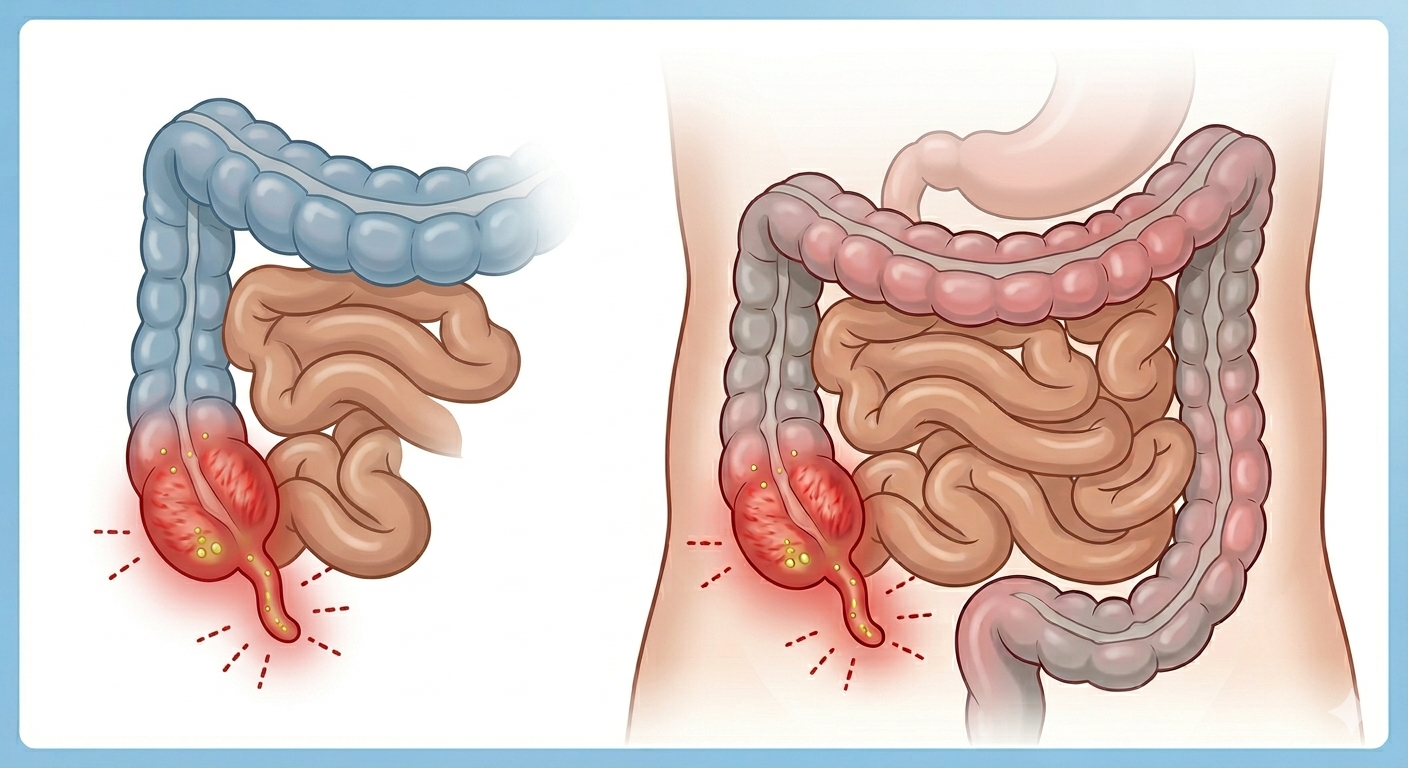
Acute appendicitis is defined as the acute inflammation of the appendix. This condition is seen most commonly in older children and young adults, and is uncommon at the extremes of age. The disease is more frequently observed in affluent societies, which may be due to variations in diet; specifically, a diet with low bulk or cellulose and a high protein intake often precipitates appendicitis.
Appendicitis is one of the most common surgical emergencies encountered by general surgeons. Sometimes, acute appendicitis can become highly dangerous because the appendix is a cul-de-sac (closed at one end) and the appendicular artery is an end artery. Recurrent attacks of acute appendicitis can also occur, with an incidence rate of 15–20%.
Signs and Symptoms
- Pain: The pain is severe and colicky. It is initially felt in the umbilical region due to the distension of the appendix. After a few hours, the pain localizes in the right iliac fossa. This is called migratory pain, which is the most reliable symptom of acute appendicitis.
- Vomiting: Vomiting occurs once or twice due to reflex pylorospasm. It contains stomach contents; however, it is never frequent.
- Anorexia: Appendicitis is unlikely in patients with a normal appetite. Usually, patients experience anorexia (loss of appetite).
- Fever: The fever is typically low-grade (around 100°F) and indicates a bacterial infection.
- Constipation: Constipation is a usual feature, except in pre-ileal and post-ileal appendicitis, where diarrhea is produced due to the irritation of the ileum.
- Cough Tenderness: This indicates inflammation of the parietal peritoneum. It is an important physical sign that differentiates acute appendicitis from right-sided ureteric colic.
- McBurney’s Point: Tenderness and rebound tenderness are characteristically present at McBurney’s point.
- Guarding and Rigidity: These signs are present in the right iliac fossa.
- Rovsing’s Sign: Palpation of the left iliac region of the abdomen produces pain in the right iliac region.
- Rupture Features: Features of generalized peritonitis are only seen when there is a rupture. Gangrene and perforation are more common in elderly patients because of atherosclerosis.
What Causes Acute Appendicitis?
- Racial and Dietary Factors: It is more common in white populations than in people of color. Young males are more frequently affected. It may be related to the Westernization of food; a diet rich in meat precipitates appendicitis, whereas a diet rich in fiber protects the individual.
- Familial Susceptibility: This is often related to having a long retrocecal appendix, in which blood supply to the distal portion is diminished, precipitating appendicitis.
- Socioeconomic Status: Appendicitis is more common among middle-class and wealthy individuals.
- Obstructive Theory: Obstruction of the appendiceal lumen due to fecaliths, worms, ova, or cysts of Entamoeba causes obstructive appendicitis. This is seen in approximately one-third of cases.
- Non-Obstructive Theory: This is caused by bacteria such as E. coli, Enterococcus, Pseudomonas, and various anaerobes, which produce diffuse inflammation of the appendix. This appears to be a more common cause than physical obstruction.
Complications of Acute Appendicitis
- Complicated Appendicitis: Acute appendicitis accompanied by perforation, a large abscess, or a phlegmon.
- Pseudoappendicitis: Acute ileitis following a Yersinia infection, which mimics appendicitis. It can also be caused by Crohn’s disease.
- Stump Appendicitis: This is the inflammation and infection of the appendiceal stump if too large a stump is left behind during a previous surgery. It may require a stump appendectomy. It is crucial to ligate and divide at the very base of the appendix to avoid this complication.
- Rupture: Rupture of the appendix causes generalized peritonitis, carrying a 10–20% mortality rate. Treatment involves an immediate laparotomy, appendectomy, peritoneal washing, and subsequent drainage of the peritoneal cavity.
- Appendicular Mass: Following an attack of acute appendicitis, the infection may be sealed off by the greater omentum, cecum, and terminal ileum. This results in a tender, soft-to-firm mass in the right iliac fossa. The presence of a mass is a contraindication for immediate appendectomy because it is highly difficult to isolate the appendix. Attempting removal at this stage may result in a fecal fistula. It is managed conservatively using the Ochsner-Sherren regimen.
- Perforated Appendicitis: The incidence rate is about 8–10%, and it is more common in children and elderly patients. A delay in seeking medical treatment is the primary factor. Pain usually localizes to the right lower quadrant if the perforation is walled off by surrounding intra-abdominal structures, including the omentum.
- Appendicular Abscess: If the infection is not properly controlled following an attack, an abscess can develop near the appendix. These can be retrocecal, post-ileal, perileal, pelvic, or subcecal abscesses. Clinically, it presents with a high-grade fever, chills, and a tender, boggy swelling in the right iliac fossa or the right lumbar region.
How Acute Appendicitis Diagnosed?
- Total WBC Count: The total white blood cell count is increased above 10,000 cells/mm³ in most patients (95%). A count rising above 20,000 cells/mm³ suggests complicated appendicitis with gangrene or perforation.
- C-Reactive Protein (CRP): CRP levels are elevated, reflecting the acute inflammatory condition.
- Plain X-ray (Abdomen Erect): This is taken primarily to rule out free air from perforation or an intestinal obstruction. It may show dilated small bowel loops in the right iliac fossa.
- Presence of a Fecalith: Seeing a fecalith on a plain X-ray is highly suggestive of acute appendicitis.
- Ultrasound (USG): An ultrasound can demonstrate a non-compressible, aperistaltic tubular organ with a thickened wall. It can also be used to elicit localized probe tenderness.
- CECT (Contrast-Enhanced Computed Tomography): CECT is the investigation of choice, especially when the diagnosis is unclear or the presentation is atypical. It is contraindicated in pregnant women.
Conventional Treatment of Acute Appendicitis
- Emergency Appendectomy: This is offered when a patient presents within 24 to 48 hours of the onset of abdominal pain.
- Laparoscopic Appendectomy: Laparoscopic surgery has become increasingly popular due to less postoperative pain and speedier recovery times. The benefits are maximum for obese patients, women, and the elderly.
Clinical Note: While conventional treatments like emergency open or laparoscopic appendectomy are indicated for typical acute cases, homoeopathic medicines are not recommended or utilized for symptom relief due to the risk of progression.
Homoeopathic Approach and Suggested Medicines
Homeopathy may be considered in managed cases, provided it is not an absolute surgical emergency. If an extreme emergency arises—indicated by intense, worsening pain or signs of perforation—the patient requires immediate conventional medical intervention and stabilization before any homeopathic therapies can be considered. When prescribed by a physician based on the totality of symptoms, the following homoeopathic medicines are noted in homoeopathic literature:
- Belladonna: Known for sudden and violent symptom onset. It is largely used in the earliest stages of inflammation where patients experience a throbbing pain in the abdomen with extreme sensitivity to external impressions like light touch.
- Colocynthis: Indicated when a patient suffers from bruised, sharp, or cutting pains in the abdomen. Patient often experiences agonizing abdominal pain associated with impatience and irritability, frequently finding relief by bending double.
- Pyrogenium: A homeopathic nosode basically used in the later stages of septic conditions. In relation to abdominal symptoms, it addresses cutting pain with bloating and tenesmus (a distressing sensation of incomplete evacuation) of the bladder and rectum.
- Hepar Sulphuricum: Used to address splinter-like sticking pains accompanied by hypersensitivity in the abdomen. Pain is usually aggravated by lying on the painful side. Burning and heaviness in the stomach after meals are additional indicators.
- Apis Mellifica: Indicated in cases presenting with stinging and burning pains. It is selected to relieve abdominal sensitivity and localized, stinging distress.
- Bryonia Alba: Recommended when abdominal pain is sharply aggravated by the slightest motion or exertion. It is characteristically indicated when accompanied by an intense thirst and a dry tongue.
- Arnica Montana: Primarily an injury remedy given when a patient experiences a sore, lame, and bruised feeling all over the body, or feels as though the stomach is pressing against the spine. Homeopathic physicians consider it as a post-surgery medicine to manage bruising and promote tissue recovery.
- Other remedies: Homeopathic physicians also recommend medicines such as Arsenicum Album, Ferrum Phosphoricum, Lachesis, Lycopodium, and Rhus Toxicodendron, selected strictly according to the individualized totality of symptoms.
Conclusion
In homeopathy, natural substances are administered in highly potentized, diluted states, which frequently raises questions within mainstream medical science regarding its mechanism. However, many patients report symptom relief with minimal side effects. While some of the suggested medicines may help alleviate discomfort during the early, uncomplicated stages of the condition. However, surgical intervention remains the definitive standard of care recommended by doctors for acute, severe, or complicated appendicitis.
References
- Homeopathy 360: A Cure of Acute Appendicitis Using Frequent Homeopathic Doses in Solution
- National Center for Biotechnology Information (NCBI): PMC5938417
- William Boericke: Boericke’s New Manual of Homeopathic Materia Medica
