
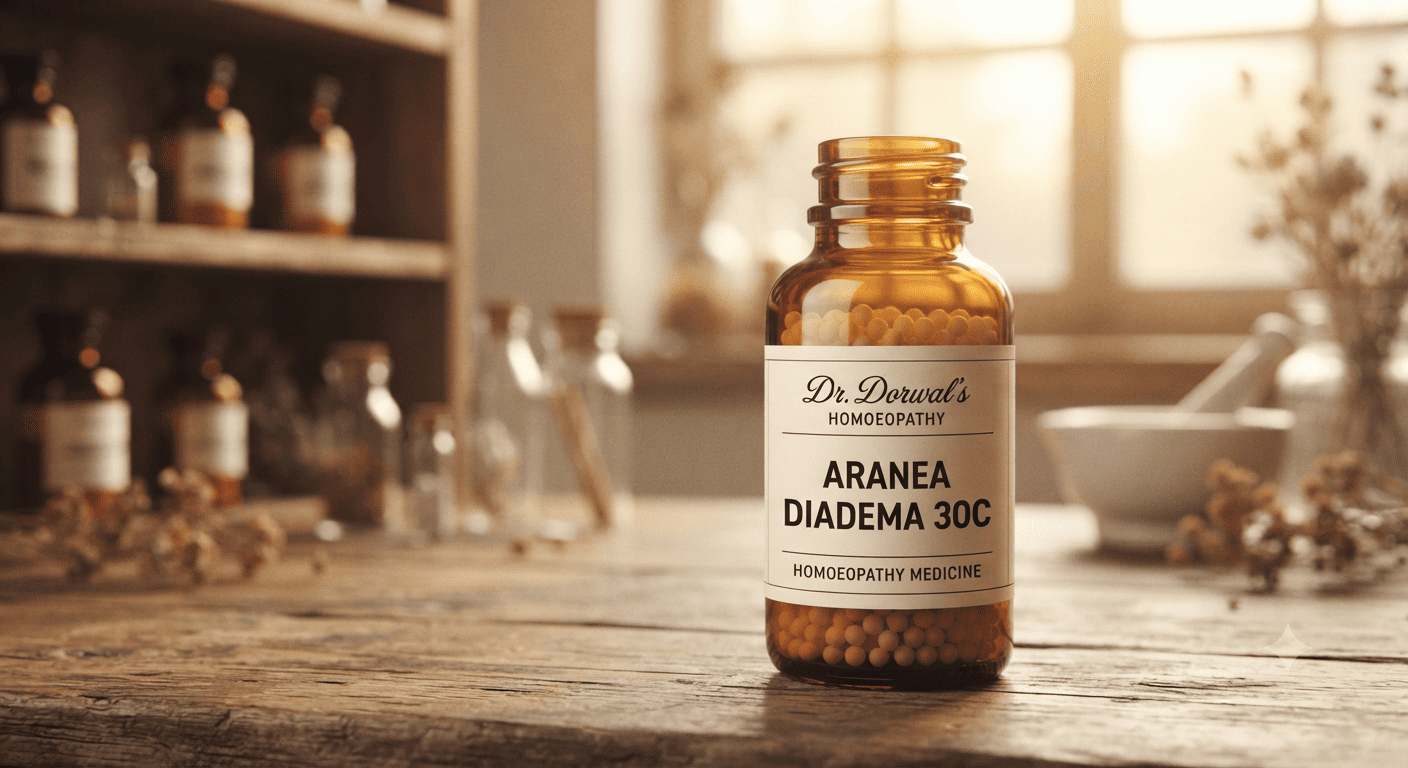
Aranea Diadema (the Papal-Cross Spider) is a quintessential homoeopathic remedy for individuals who exhibit a profound, constitutional sensitivity to environmental factors. Like many spider-derived remedies, it exerts a potent influence on the nervous system, with its clinical picture dominated by periodicity, intense coldness, and a marked susceptibility to dampness.
Key Clinical Indications & Uses
Therapeutic profile of Aranea Diadema is defined by its affinity for “hydrogenoid constitution”—a state where the patient cannot tolerate damp, chilly environments:
- Periodicity and Coldness: Hallmark of this remedy is a recurring chilliness that penetrates to the very bones and is not relieved by any external heat. Symptoms, including fevers and colic, characteristically return at the same hour daily.
- “Hydrogenoid” Sensitivity: This remedy is indicated for those who are unable to live near fresh water, lakes, or in damp, chilly regions. Exposure to damp weather or rain consistently aggravates their condition.
- Sensory Distortions of Swelling: Patients often experience a subjective sensation that their limbs are enlarged or heavier than they truly are. A characteristic symptom is waking at night feeling as if the hands are twice their natural size.
- Neuralgic and Bone Pains: It is highly indicated for neuralgic pains (such as right-sided trifacial neuralgia or intercostal pain) that travel from the periphery inward. It also addresses deep-seated bone pains in the extremities, particularly in the os calcis (heel bone).
- Splenic and Abdominal Distress: It is a key remedy for cases of swollen spleen or abdominal heaviness, often described as the sensation of carrying a “stone” in the lower abdomen.
Administration & Dosage
- Dose: In clinical practice, it is utilized in wide range from Mother tincture (Q) to 30C potency, depending on the chronicity of constitutional state.
- Modalities: Symptoms are characteristically worse during damp weather, late in the afternoon, and at midnight. A curious modality is that the patient feels better by smoking tobacco in open air.
Dr. Dorwal’s Perspective
In my clinical practice, Aranea Diadema is a remedy that I reach for when I encounter the “damp-sensitive” patient. These are individuals who feel perfectly well until they spend time near a lake, in a humid basement, or during a rainy season—at which point their chronic aches, neuralgias, or digestive distress flare up with a clockwork regularity.
What I find most clinically instructive is the sensation of enlargement in the hands and feet. When a patient reports waking in the night because their hands feel swollen and heavy, despite no visible edema, I immediately think of the spider family and specifically Aranea. It is a remedy that “resets” the patient’s internal thermometer, helping them regain a tolerance for the environment they currently struggle to inhabit. For the practitioner managing resistant malarial constitutions or complex neuralgias that worsen with every rain cloud, Aranea Diadema provides a specialized, constitutional anchor.
Disclaimer: This content is for informational purposes only. Homoeopathic medicines should be taken under the guidance of a qualified homoeopathic physician. Do not self-medicate for chronic or serious medical conditions, and always seek professional advice for any health concerns.
Frequently Asked Questions (FAQs)
It is a state of abnormal sensitivity to damp and cold. Patients with this constitution struggle to live near fresh water or in humid/chilly environments, which consistently trigger or aggravate their symptoms.
It is a subjective keynote of the remedy; patient wakes in the night feeling as though their hands and forearms are twice their natural size or “asleep,” even without objective physical swelling.
It is indicated for neuralgic pains that travel from periphery toward the center (inward), often affecting the trifacial or intercostal nerves.
A curious, specific modality of Aranea is that the patient often feels better by smoking tobacco, particularly when in the open air.
