
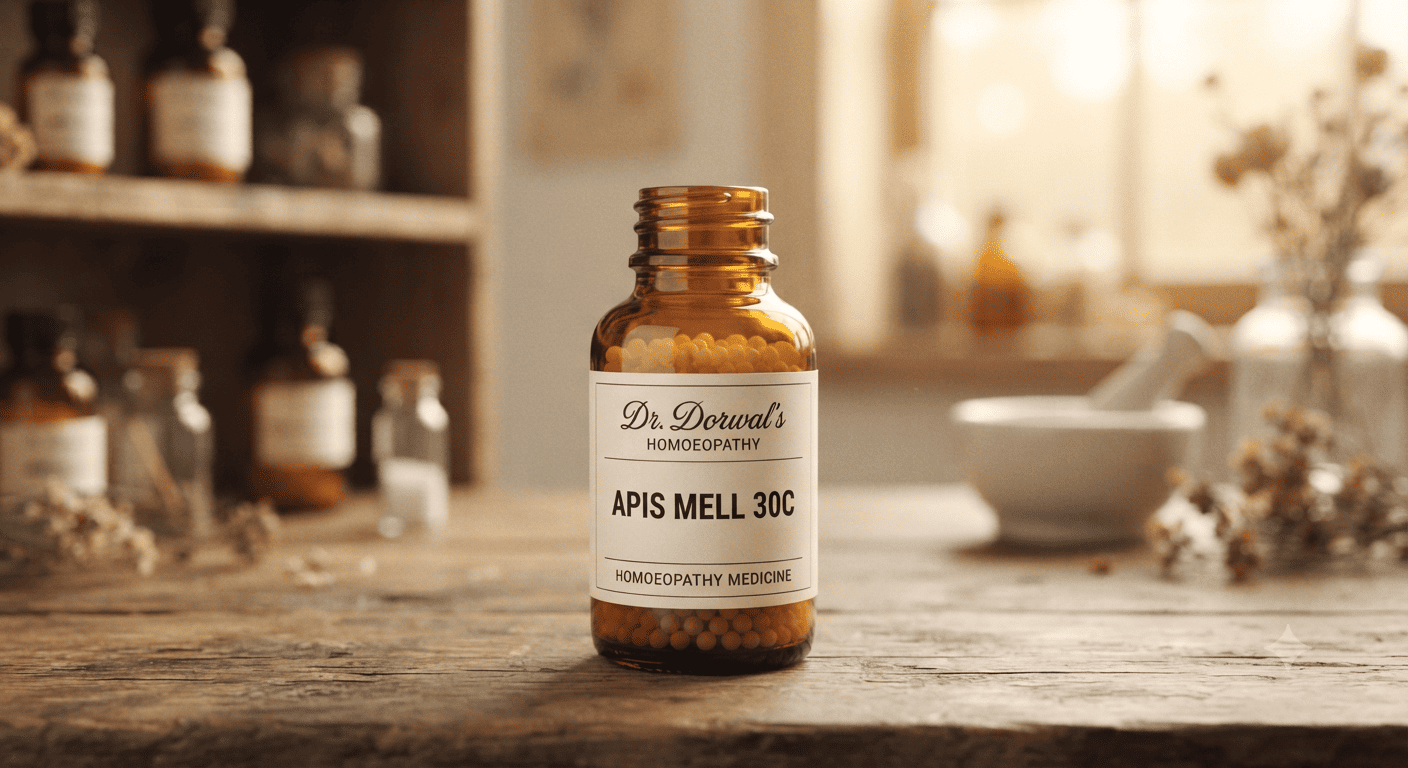
Apis Mellifica is a preeminent remedy in the homoeopathic pharmacopoeia, revered for its profound ability to address inflammatory and dropsical states. Derived from the honey-bee, it encapsulates the quintessential qualities of the sting: rapid onset of swelling, intense stinging pain, and a marked intolerance to heat. It acts primarily on the cellular tissues, serous membranes, and the skin, serving as a vital “serous regulator” in acute disease.
Key Benefits & Uses
Apis Mellifica is the primary clinical consideration for conditions involving abnormal fluid accumulation and reactive inflammation:
- Edema & Serous Effusion: It is the go-to remedy for localized or generalized puffiness. Whether it presents as peritonitis, pleurisy with effusion, or generalized anasarca, Apis is indicated when tissues appear swollen, shiny, and rosy-red.
- “Bee-Sting” Pain Profile: The hallmark sensation is a sharp, stinging, or burning pain, often accompanied by extreme sensitivity to touch or pressure. Patient typically feels worse in warm rooms and significantly better with cold applications or in open air.
- Inflammatory Landscapes: It is highly effective for erysipelatous inflammations (where redness and swelling are prominent) and parenchymatous tissue inflammation, such as in acute nephritis or ovaritis—particularly when localized to the right side.
- Mucous Membrane Affections: It addresses fiery-red, swollen, and raw-feeling mucous membranes. The throat often presents with swollen, puffy tonsils and a sensation of a fishbone stuck in the throat, while the tongue may appear glossy, as if varnished.
- Urinary & Reproductive Support: It is invaluable for burning, stinging urinary symptoms and is a major remedy for ovarian pathologies, including cysts and inflammation, often accompanied by a sense of bearing-down or tightness.
Administration & Uses
- Potency Selection: A wide range is used, from Mother tincture (Q) to the 30th potency or Higher. In cases of significant edematous swelling, lower potencies are often preferred to stimulate the desired physiological response.
- Absorption: Avoid eating or drinking for 20 minutes before or after administration to ensure optimal sublingual absorption.
Dr. Dorwal’s Perspective
In my clinical practice, Apis Mellifica is an indispensable tool when the body’s “waterworks” and inflammatory responses go into overdrive. When I see a patient whose skin is puffy, shiny, and stinging—where the slightest touch causes them to wince—I look immediately to Apis.
It is a remedy of high contrast; the patient is often thirst-less, yet their tissues are filled with fluid. I often describe it as the body’s “emergency cooling system”—it excels in those acute, hot, red, and angry inflammatory states where the patient feels as if they are smoldering. Whether it is a child with a fiery-red, puffy throat or a patient suffering from sudden-onset synovitis or hives, Apis provides that crucial physiological signal to the tissues to release excess and return to equilibrium. It is a remedy that rewards the observant physician who recognizes the “bee-sting” signature in the patient’s presentation.
Disclaimer: This content is for informational purposes only. Homoeopathic medicines should be taken under the guidance of a qualified homoeopathic physician. Do not self-medicate for chronic or serious medical conditions, and always seek professional advice for any health concerns.
Frequently Asked Questions (FAQs)
While it is the premier remedy for edematous and inflammatory swelling characterized by stinging and burning, it is not a “cure-all” for every type of physical enlargement. It is most effective when the patient’s symptoms—such as thirstlessness, intolerance to heat, and sensitivity to touch—align with the remedy’s specific profile.
Apis has a strong affinity for the female reproductive system, particularly the ovaries. It is indicated when there is a sensation of stinging or burning pain, often accompanied by tenderness, bearing-down sensations, and a marked aggravation from heat.
Yes, it is excellent for the aftereffects of insect bites or allergic reactions characterized by sudden, stinging, red, and edematous swellings. It helps soothe the inflammatory response and reduce the characteristic “puffing up” of the tissues.
The “stinging-burning” pain sensation combined with an intolerance to heat and a distinct thirstlessness. When these three elements appear together in the presence of edema, Apis Mellifica is almost always the remedy of choice.
