
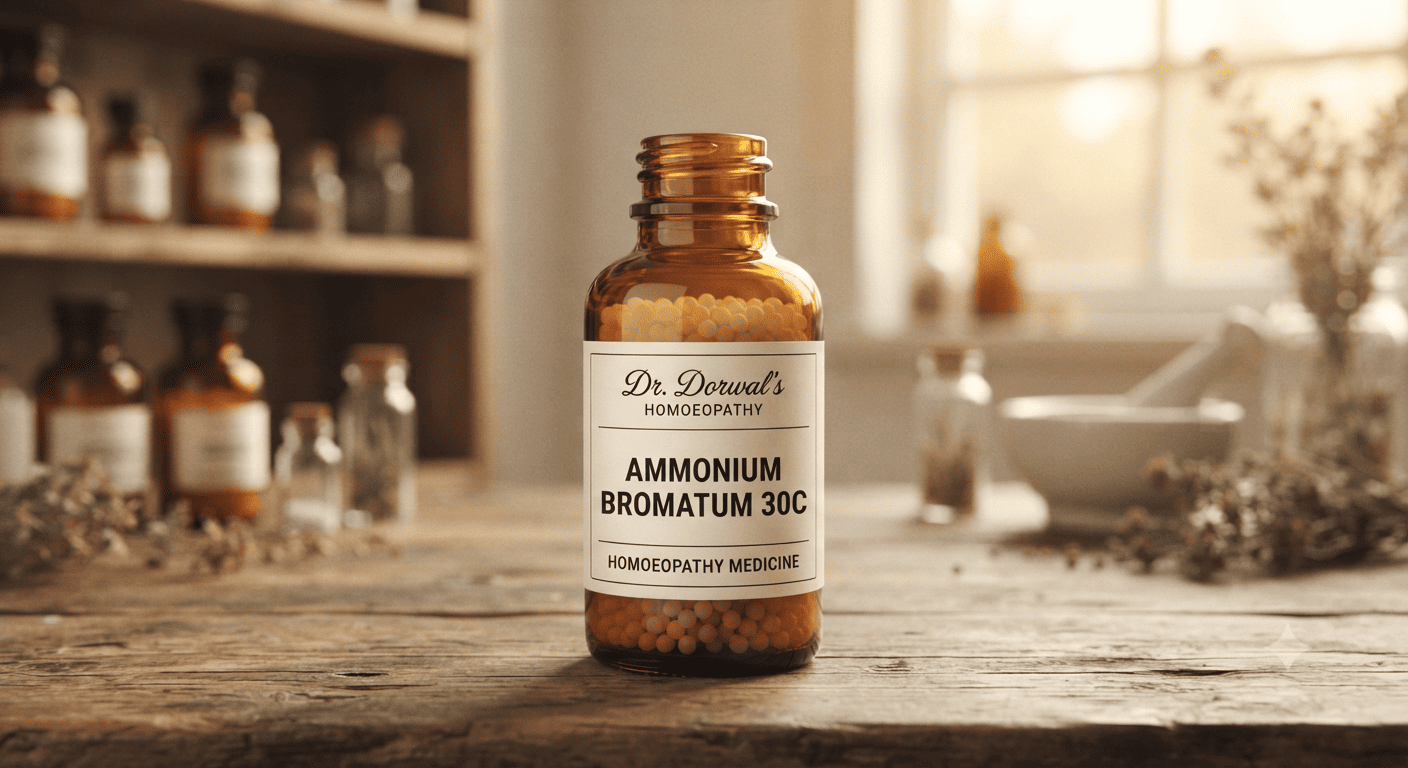
Ammonium Bromatum (Bromide of Ammonia) is a therapeutic agent with a focused sphere of action on upper respiratory tract, neurological system, and metabolic regulation. It is a remedy of “spasm” and “constriction,” often indicated in cases where catarrhal irritation progresses to spasmodic, nocturnal disturbances.
Key Clinical Indications & Uses
Therapeutic profile of Ammonium Bromatum is centered on its ability to soothe irritability and resolve chronic catarrhal states:
- Laryngeal and Pharyngeal Catarrh: This remedy is highly effective for chronic catarrh affecting the throat and voice box—frequently referred to as “speakers’ catarrh.” It addresses the smarting, burning sensations in fauces and a persistent tickling in throat that induces a dry, spasmodic cough.
- Nocturnal Respiratory Distress: A hallmark of this remedy is a spasmodic cough that is dramatically worse at night. Patients often wake at 3:00 AM feeling suffocated, with a continuous cough that is aggravated by lying down. It is also a valuable consideration in the management of Whooping Cough.
- Neuralgic and Constrictive Pains: It addresses sensations of constriction throughout the body—in the head, chest, and legs. It is also indicated for neuralgic headaches accompanied by cerebral congestion, often described as a tight “band” around the head.
- Ocular Irritation: It is indicated for redness and swelling of the eyelid edges and the Meibomian glands, often accompanied by a sensation of eyeballs being enlarged and painful.
- Behavioral Irritability: A unique clinical curiosity of this remedy is a persistent, irritable sensation under the fingernails, which the patient feels compelled to relieve by biting their nails.
Administration & Uses
- Dose: In clinical practice, it is typically utilized in 30C potency.
Dr. Dorwal’s Perspective
In clinical practice, Ammonium Bromatum is a specialized remedy for the patient whose cough dictates their sleep. When a patient reports waking consistently at 3:00 AM with a strangling, spasmodic cough that only intensifies as they lie down, this remedy is frequently the key. It calms the hyper-irritable mucous membranes of the throat, providing relief where vocal cords have been strained by chronic catarrh.
I also find it fascinating as a remedy for “constriction.” Whether that constriction presents as a band around the head in a neuralgic patient or as a suffocating sensation in the chest, Ammonium Bromatum seems to relax that tightened physiological state. It is a remedy that proves that by addressing the peripheral irritation of throat, we can often alleviate the systemic tension that impacts the entire nervous system.
Disclaimer: This content is for informational purposes only. Homoeopathic medicines should be taken under the guidance of a qualified homoeopathic physician. Do not self-medicate for chronic or serious medical conditions, and always seek professional advice for any health concerns.
Frequently Asked Questions (FAQs)
A dry, spasmodic cough that is worse at night, specifically when lying down, often waking the patient at 3:00 AM.
It refers to chronic throat and vocal cord irritation, for which Ammonium Bromatum is a primary remedy.
It causes redness and swelling of the eyelid edges and Meibomian glands, with a feeling of pain and enlargement of the eyeballs.
30C potency is typically used in clinical practice.
