
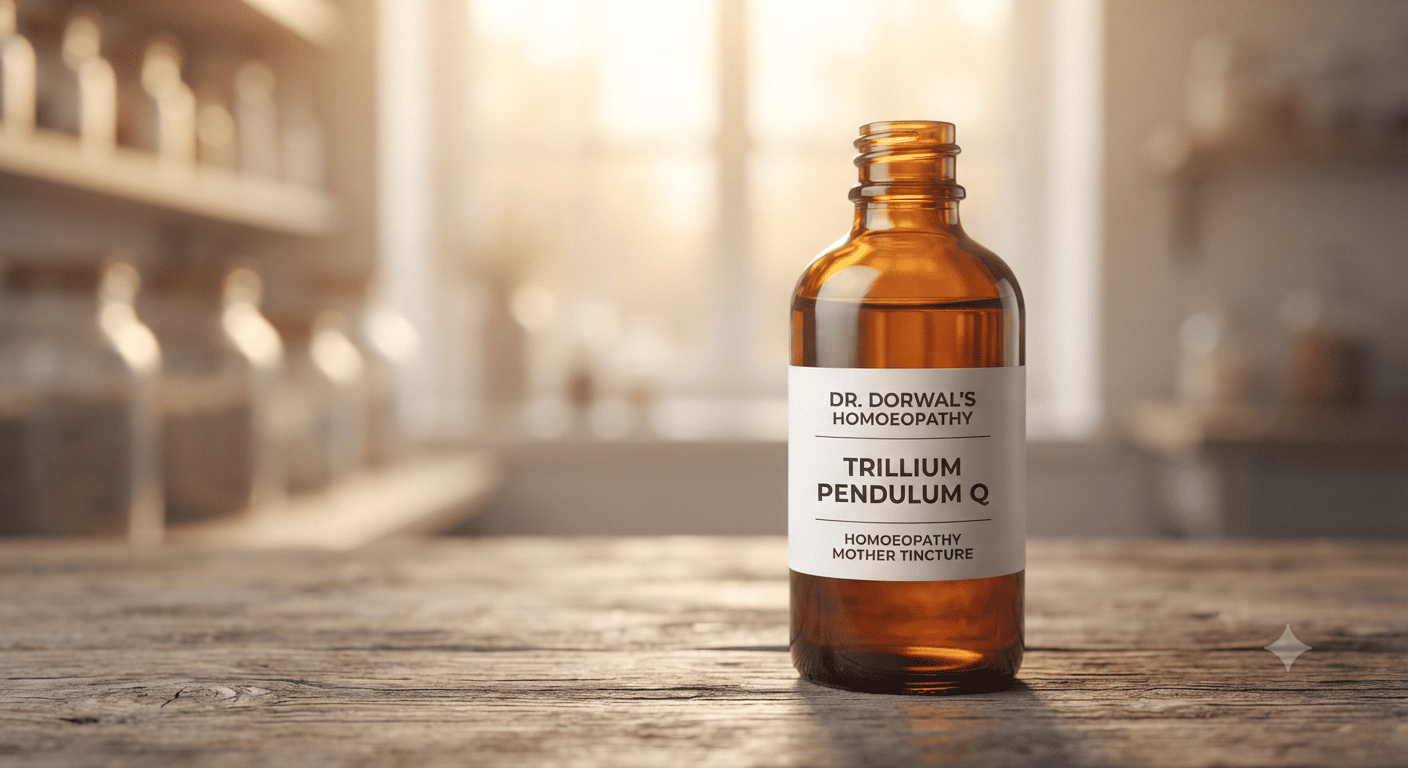
Trillium Pendulum, or White Beth-root, is a prominent homoeopathic remedy utilized as a general haemorrhagic agent. It is particularly valued for its capacity to address various bleeding states, often accompanied by marked sensations of faintness and dizziness.
Key Clinical Indications & Uses
The therapeutic profile of Trillium Pendulum spans multiple systems, with a particular affinity for haemorrhagic conditions:
- Haemorrhagic States: It is indicated for a wide array of bleeding disorders, including uterine haemorrhage, haemoptysis (spitting of blood), haematemesis (vomiting blood), epistaxis (nose-bleed), and bleeding from the gums or after tooth extraction.
- Female Reproductive Health: A primary remedy for uterine issues, it is used for metrorrhagia at the climacteric, haemorrhage from fibroids, and cases of threatened abortion. Patients often report a sensation that the hips and back are “falling to pieces,” which may be relieved by tight bandages. It also addresses prolapse with bearing-down sensations, copious/stringy yellow leucorrhea, and post-labor urinary dribbling.
- Gastrointestinal Distress: Useful in chronic diarrhoea involving bloody mucus, and in dysentery where the passage may consist almost entirely of blood.
- Respiratory Affections: Indicated for phthisis accompanied by copious, purulent expectoration and spitting of blood. Symptoms include shooting chest pains and suffocative attacks with irregular breathing.
- Cranial and Sensory Symptoms: Includes frontal headache worsened by noise, a sensation of the eyeballs being too large, and blurred vision where objects may appear bluish.
Administration and Therapeutic Modalities
- Dose: It is typically administered in the form of a Mother tincture (Q) or in lower potencies(Such as 30C).
Dr. Dorwal’s Perspective
In clinical practice, Trillium Pendulum is an essential remedy when confronted with active, bright-red haemorrhage, especially in gynecological cases. I find it particularly effective for patients who experience that classic “falling to pieces” sensation in the pelvis, which often requires physical support like a tight bandage for relief. While its utility in haemorrhages is well-documented, it is also a powerful consideration for advanced respiratory cases involving copious expectoration. As always, the selection of this remedy is guided by the exact modality of the haemorrhage and the patient’s constitutional state.
Disclaimer: This content is for informational purposes only. Homoeopathic medicines should be taken under the guidance of a qualified homoeopathic physician. Do not self-medicate for chronic or serious medical conditions, and always seek professional advice for any health concerns.
Frequently Asked Questions (FAQs)
It is primarily a haemorrhagic medicine used for bleeding from the uterus, lungs, stomach, nose, and gums.
It is indicated when the patient feels as though the hips and back are falling apart, often accompanied by a bearing-down sensation associated with prolapse.
It can cause blurred vision, where objects may appear to have a bluish tint.
It is prescribed in the form of a Mother tincture (Q) or lower potencies (Such as 30C).
