
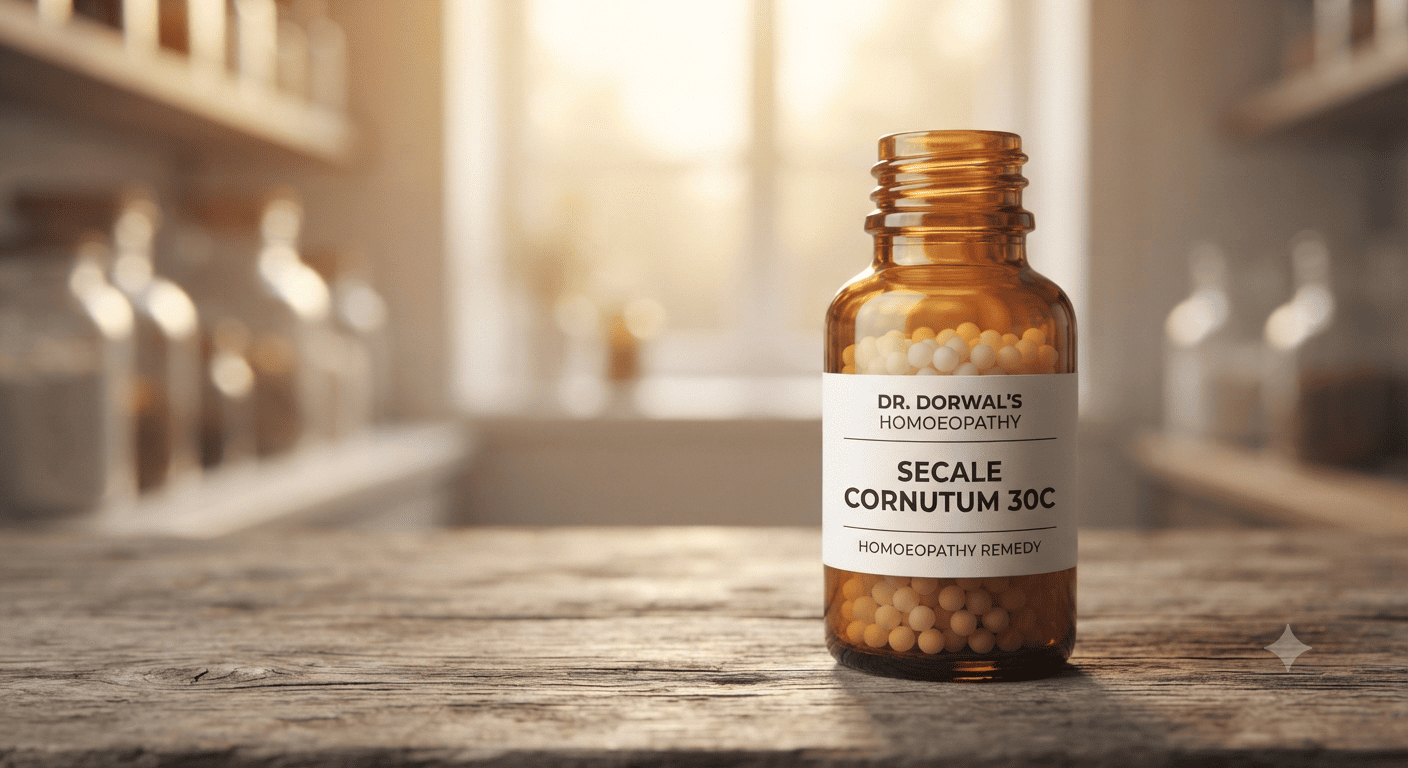
Secale Cornutum, derived from Claviceps purpurea (Ergot), is a powerful homoeopathic remedy primarily recognized for its action on the unstriped muscular fibers, which leads to a generalized constringent sensation throughout the body. It is characterized by an anaemic condition, profound coldness, numbness, and a unique modality: patients typically feel better from cold and have an aversion to heat.
Key Clinical Indications & Uses
Secale Cornutum is indicated for a wide variety of systemic and localized conditions:
- Circulatory and Dermal Conditions: The remedy is used for conditions involving gangrene, petechiae, mottling of the skin with a dusky-blue tinge, and Raynaud’s disease. The skin is often shriveled, numb, and feels cold to the touch, yet the patient cannot tolerate any covering.
- Haemorrhagic States: It is indicated for passive, continued oozing of thin, fetid, watery black blood.
- Female Reproductive Health: Secale is a significant remedy for menstrual colic with coldness, passive uterine haemorrhages in feeble or cachectic women, and cases of threatened abortion around the third month. During labor, it is used when there is a lack of expulsive action despite a relaxed state, or for secondary puerperal haemorrhage.
- Digestive and Urinary Systems: Patients may exhibit an unnatural ravenous appetite, unquenchable thirst, and cholera-like stools that are thin, putrid, and bloody. Urinary symptoms include paralysis of the bladder, retention with unsuccessful urging, and enuresis in the elderly.
- Neurological and Musculoskeletal Symptoms: It is indicated for spinal irritation, formication (a sensation of insects crawling under the skin), numbness, and violent cramps. In the extremities, there is often icy coldness, trembling, and a staggering gait.
Administration & Modalities
- Modalities: Symptoms are characteristically worse from heat and warm covering. They are better from cold, uncovering, rubbing, and stretching out the limbs.
- Dosage: The potency range for homoeopathic use is from 30C to 200C.
- Clinical Note: Regarding non-homoeopathic usage in puerperal haemorrhages, clinicians must remember Pagot’s law: “As long as the uterus contains anything, be it child, placenta, membranes, clots, never administer Ergot”.
Dr. Dorwal’s Perspective
Secale Cornutum presents a very specific clinical picture—one of profound coldness paired with a paradoxical intolerance of heat. In my practice, I consider this remedy for patients who present with signs of impaired circulation, such as shriveled skin or cold, numb extremities, particularly in cases involving cachectic or feeble constitutions. It is an essential remedy for managing passive haemorrhages where the blood is thin and dark, and it remains a critical consideration for the management of puerperal complications when the uterine contractions are inadequate. Its unique ability to influence the unstriped muscular fibers makes it a cornerstone remedy for conditions ranging from vascular disorders to uterine inertia.
Disclaimer: This content is for informational purposes only. Homoeopathic medicines should be taken under the guidance of a qualified homoeopathic physician. Do not self-medicate for chronic or serious medical conditions, and always seek professional advice for any health concerns.
Frequently Asked Questions (FAQs)
The skin is often shriveled, numb, and mottled with a dusky-blue tinge. There is a great aversion to heat and an intolerance of being covered, even though the skin feels cold to the touch.
It is indicated during labor when expulsive action is absent despite a relaxed state, and it is also used for secondary puerperal hæmorrhage resulting from incomplete involution of the uterus.
Symptoms are worse from heat or warm covering and are better from cold, uncovering, and stretching.
Per Pagot’s law, it should never be administered as long as the uterus contains anything, such as a child, placenta, membranes, or clots.
