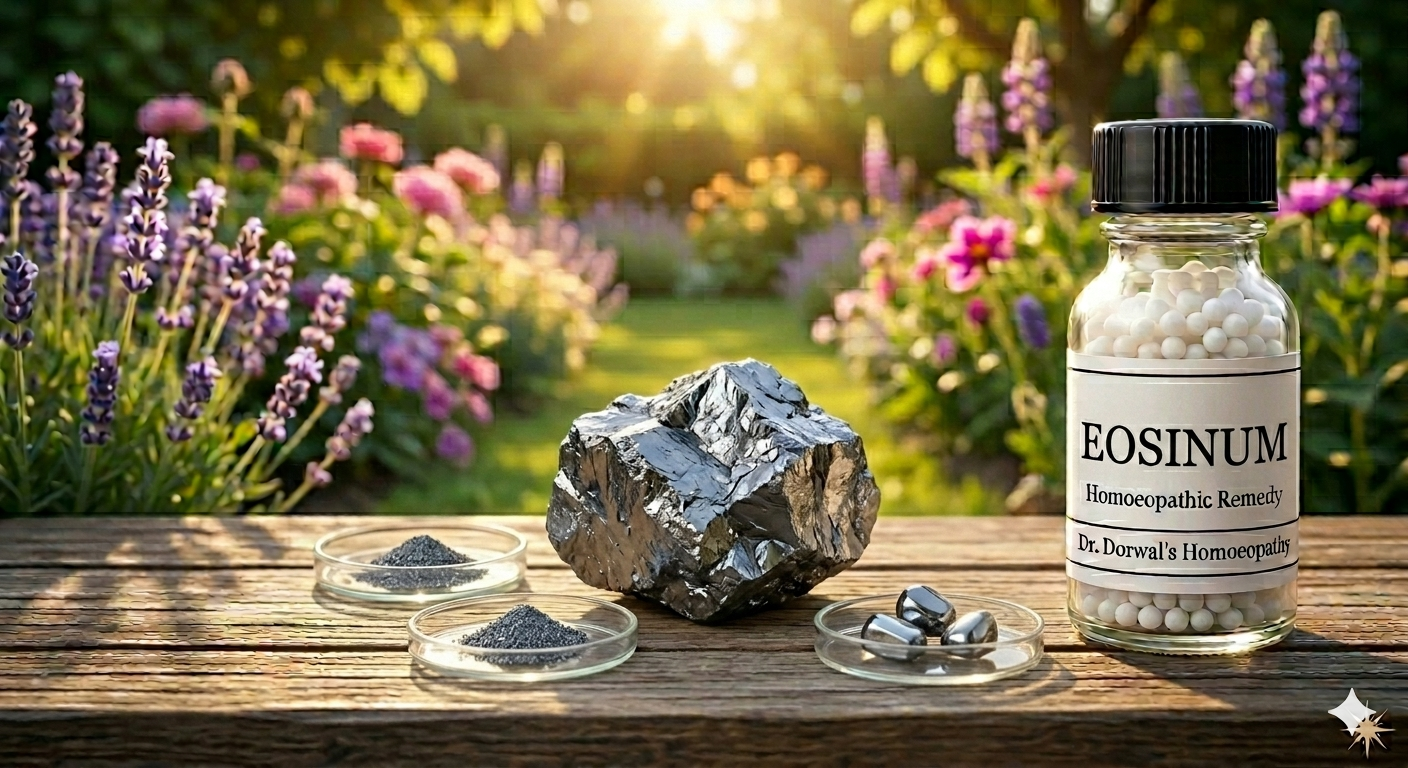
Quick Overview: Eosinum is a homoeopathic remedy chiefly used for polyarthritis and complicated skin conditions marked by burning sensations. It is indicated for burning under the nails and soles, redness of palms and knee-caps, tongue symptoms, and a peculiar sensation of being tall with vertigo. Commonly given in 30C or 200C potency under professional guidance.
Eosinum is a homoeopathic medicine notably proved in various potencies by Dr. B. C. Woodbury. Its unique symptomatology covers skin, mucosal membranes, and nervous system symptoms. In clinics, Physicians use it to support the treatment of complicated cases, such as arthritis and cancer. Its remedy picture is distinctive: burning that shifts location, redness of the palms and knee-caps, and an unusual sensation of feeling tall accompanied by vertigo.
Clinical Indications, Benefits & Uses
Eosinum covers the following characteristic symptoms:
- Dermatological Manifestations: Strongly recommended for relieving a burning sensation in different areas of the skin.
- Localized Burning & Redness: Clinically effective for burning sensations specifically under the fingernails and toenails, as well as on the soles of the feet. Also used for redness of the palms.
- Arthritic & Joint Symptoms: Indicated in the treatment of polyarthritis, with a unique symptomatology covering itching and redness over the knee-caps.
- Neurological & Sensory Disturbances: Used where patients feel a strange sensation of being unusually tall, often accompanied by a tendency to vertigo.
- Oral Symptoms: Covers oral symptoms like redness, burning, and numbness of the tongue.
- Itching Modalities: Covers a unique itching profile where the itching shifts location after scratching, giving temporary relief.
Eosinum vs. Other Homoeopathic Medicines
Several homoeopathic remedies overlap with Eosinum in covering burning pains, joint symptoms, or skin eruptions. The table below highlights the key differentiating features to help understand where Eosinum fits among related medicines.
| Medicine | Key Symptom Focus | Modality (Better/Worse) | Best Suited For |
| Eosinum | Burning under nails & soles, shifting itching, redness of palms/knee-caps, sensation of being tall with vertigo | Burning relieved temporarily by scratching; symptoms shift location | Polyarthritis and skin/nerve cases with peculiar burning and shifting symptoms |
| Apis Mellifica | Stinging, puffy, oedematous swelling; burning, stinging pains | Worse from heat and touch; better from cold applications | Acute joint swelling with stinging pain and puffiness |
| Cantharis | Intense, raw burning pains on skin and mucous membranes | Worse from touch; better from cold applications | Severe burning skin eruptions and blisters |
| Rhus Toxicodendron | Joint stiffness, restlessness, pain on first motion | Worse on initial motion and rest; better with continued motion | Rheumatic and arthritic stiffness that eases with movement |
| Ledum Palustre | Ascending joint pains, coldness of affected part | Worse from heat and at night; better from cold applications | Polyarthritis starting in lower joints and moving upward |
Note: This comparison is for general educational understanding only. Remedy selection must always be individualized by a qualified homoeopathic physician based on the totality of symptoms.
Administration & Therapeutic Modalities
- Potency & Dosage: According to historical provings, the remedy is typically given in the second decimal (1% solution) potency. In clinical practice, it is commonly used in potencies of 30C or 200C.
- Clinical Application: Practitioners observe the patient for characteristic burning sensations and distinct skin symptoms, such as redness on the palms and itching around the knee-caps, in order to decide on the right treatment approach.
Dr. Dorwal’s Perspective
In my clinical practice, I use Eosinum to manage the conditions that shows shifting and burning sensory experiences. It is useful for the patients whose symptoms do not fit into the specific disease classification. I strictly focus on the chief symptoms like ‘burning’ sensation and feeling of height or vertigo, while using Eosinum. Its administration stabilize the skin and nervous system symptoms. In one line I can say that Eosinum is a well proved homoeopathic medicine that chiefly targets the nervous and skin symptomatology. Eosinum administration need careful and personalized monitoring by physician for long-term, deeply rooted health issues.
Disclaimer: This content is for informational purposes only. Homoeopathic medicines should be taken under the guidance of a qualified homeopathic physician. Do not self-medicate for chronic or serious medical conditions, and always seek professional advice for any health concerns.
Frequently Asked Questions (FAQs)
In homoeopathy, Eosinum is utilized for various conditions covering symptoms of polyarthritis and dermatological conditions marked by burning and redness.
Patient feels burning sensation, specifically under the fingernails, toenails, and on the soles of the feet.
Patients may experience a sensation of being very tall, often accompanied by a vertigo.
Eosinum is characterized by its tendency to shift the itching locations after patient scratches the area, which provides temporary relief.
Eosinum should only be taken under the supervision of a qualified homoeopathic physician, especially for long-term or chronic conditions, as potency and duration need individualized monitoring.
Historically, Eosinum has been referenced in materia medica for supporting complicated cases including cancer, but it should never be used as a substitute for standard oncology care and must only be considered as an adjunct under professional guidance.
Eosinum is traditionally used in the second decimal (1% solution) potency, while modern clinical practice commonly uses 30C or 200C potencies.
Self-medication is not recommended for chronic or serious conditions. Eosinum should be taken only under the guidance of a qualified homoeopathic physician.